High School Sports Medicine Names Build Your Own Art Project
| Theodore Roosevelt High School | |
|---|---|
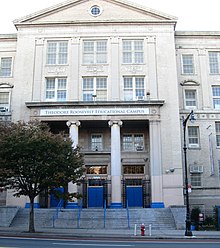 | |
| Address | |
 | |
| 500 East Fordham Road Belmont The Bronx NY 10458 U.s.a. | |
| Coordinates | 40°51′34″N 73°53′19″W / 40.859444°N 73.888611°West / xl.859444; -73.888611 |
| Information | |
| Erstwhile proper noun | Roosevelt High School |
| Schoolhouse type | Public high school |
| Opened | November 14, 1918 (1918-11-fourteen) (school); September 1928 (1928-09) (edifice) |
| Status | closed |
| Closed | 2006 (2006) |
| School board | New York City Panel for Educational Policy |
| School district | New York Urban center Section of Didactics |
| Grades | 9–12 |
| Color(s) | scarlet and white |
| Team name | Crude Riders |
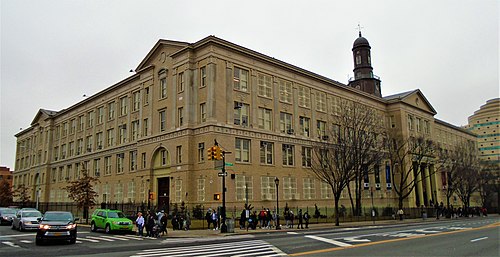
Theodore Roosevelt Educational Campus in February 2020
Theodore Roosevelt High School, originally Roosevelt High Schoolhouse, the third public high schoolhouse to open in the Bronx, New York,[1] operated from 1918 until its permanent closure in 2006. Shutting down incrementally since 2002, this large high school, initially enrolling about 4 000 students,[2] yearly dwindled, newly sharing its 1928 edifice with new, small public high schools—all pooling students for major, extracurricular activities like athletics and JROTC—a reorganization renaming the building Theodore Roosevelt Educational Campus,[three] still open up after the historic, namesake loftier schoolhouse ceased in 2006.[iv] At its November 1918 opening, Roosevelt High School operated in the building of schoolhouse PS 31.[5]
At the January 1919 decease of the Roosevelt family's preeminent fellow member, a recent U.s. president and venerated statesman, Roosevelt High School was renamed.[6] And as the Bronx led New York City's population growth,[7] its enrollment snowballed.[half dozen] Still focusing on bookkeeping and secretarial skills,[viii] Roosevelt gained more classrooms in other schools' buildings.[6] Yet in 1928, the high schoolhouse entered its ain, newly built at 500 Eastward Fordham Route, making information technology ane of America's high schools largest and best equipped.[2] At the northern edge of the Belmont section, soon a Niggling Italy, and the southern edge of Fordham University'south campus, Roosevelt's building became a community venue for organizations' meetings[9] and politicians' speeches.[x]
The school colors were red and white. The sports teams were the Rough Riders, nickname of the cavalry unit of measurement led by Colonel Roosevelt before his United states of america presidency. The high schoolhouse'due south 1930s and 1940s students participated extracurricularly at near 55% or New York Metropolis's everyman rate, about 80% citywide.[11] Still, Roosevelt was esteemed in its own niche,[12] educating for the basic workforce, the schoolhouse'due south image enduring into the 1950s.[xiii] Meanwhile, a local gang, the Fordham Baldies, menacing blacks and Hispanics in Roosevelt's vicinity, kept enrollment overwhelmingly white.[fourteen] In the 1960s, amid students citywide, truancy increased and socializing gained priority, whereby other high schools often issued diplomas one time their requirements were met via Roosevelt's evening and summer classes.[fifteen] [16]
Across the 1960s, amid economical stagflation,[17] drug selling popularized,[18] mutual at Roosevelt past 1970.[16] Every bit drug culture had eased racial hostilities, Roosevelt's blackness and Hispanic enrollment grew.[14] Although heroin lowered gang violence,[xiv] New York City teetered on defalcation in 1975,[xix] and the 1977 coma incited massive looting, triggering a domino effect of rapid urban decay,[20] including soaring criminal offense rates and white flight.[21] [22] [23] By 1980, the South Bronx, largely rubble,[24] was notorious for having the city's worst public high schools.[25] Then the crack epidemic struck.[26] Many adolescents from the city's about violent neighborhoods,[27] policed by specially corrupt officers,[28] were zoned to Roosevelt, which, having the urban center'due south highest dropout rate in 1984,[29] symbolized the educational disaster.[30]
In 1986, with a new principal, efforts began to raise Roosevelt's omnipresence.[29] Simply improvement was negligible until 1992, when the next new master, Thelma Baxter, led an amazing turnaround.[30] [31] Upon Baxter's 1999 promotion to superintendent of schools in Manhattan's Harlem section, Roosevelt's progress reversed.[30] In 2001, the city'due south Department of Education, ordered past the country'due south, allowable Roosevelt to shut down.[32] In 2002, it received its terminal freshman course.[32] In 2006, near three% graduated.[33] The Theodore Roosevelt Loftier Schoolhouse and so closed.[xxx]
From the 1920s to the 1960s, a number of eventual public figures—announcer Thelma Berlack Boozer, extra June Allyson, histrion John Garfield, baseball player Rocky Colavito, all the singers of Dion and the Belmonts, Kiss'southward lead guitarist Ace Frehley, histrion and screenwriter Chazz Palminteri, and comedian and actor Jimmie Walker—had attended the Theodore Roosevelt High Schoolhouse.[34] [35]
Origination: 1910s–20s [edit]
The setting [edit]
In the early 20th century, American educators sought to both aggrandize and tailor schooling and to extend school enrollment into boyhood, newly seen as a prime opportunity to properly socialize youth, especially to assimilate the speedily growing immigrant populations of cities.[36] Helping to define, or fifty-fifty to create, this concept of adolescence as the transition from childhood to adulthood, high schools became venues where youth vied for command over identity, behavior, and fidelity, while the 19th century'south esteem for Protestant respectability faded to the 20th century'southward emergent quests for intricate cosmopolitanism.[36] In a multiethnic city like New York, educators intentionally employed the high schoolhouse every bit a fundamental agent of socialization.[36] Inbound 1918, the Bronx had two high schools: the Morris and the Evander Childs.[37] [38] [39]
The opening [edit]
The Roosevelt Loftier Schoolhouse was organized on Nov 14, 1918, from the commercial classes comprising a Morris Loftier School annex conducted in PS 31, located at 144th Street and Mott Avenue, thereupon Roosevelt's location.[6] [5] Initially led by teacher Edward M Williams, Roosevelt's 830 students got their first principal—William R Hayward—on December nine, 1918.[half dozen] On Jan 8, 1919, two days subsequently the earlier United states President Theodore Roosevelt, a Progressive Era leader born in Manhattan, had died, New York Metropolis schools' Board of Superintendents proposed a name change, approved two days after by the New York City Board of Education.[half dozen] The next 24-hour interval, primary Hayward announced the Theodore Roosevelt Loftier School, and sought its namesake'due south spirit to preside over information technology.[6] Chop-chop growing, Theodore Roosevelt High School gained its own addendum—16 classrooms in PS 47—later that very month, on January 22, 1919.[6]
The civic [edit]
From 1900 to 1920, the population of the Bronx, the city's fastest growing borough, grew over 2 and a one-half times.[seven] The Bronx Lath of Trade ended, "It is probably due to the fact that its housing conditions are of the best that The Bronx for years has had the everyman death rate and the highest birth rate of whatsoever of the Boroughs".[7] Over those xx years, spending on Bronx building construction was substantial, averaging some $24 meg per yr, but 1921 saw record spending, over $75 meg.[7] Yankee Stadium opened in 1923.[xl] Throughout the 1920s, upscale apartments, highly coveted, rapidly went upwards along the Grand Concourse, and were promptly rented mostly by affluent doctors, lawyers, and businessmen.[41] Up to some 80% of the Concourse's residents were Jews, the grouping leading the Bronx's rapid population growth,[41] fostered by newly built subway lines, enabling rapid travel from lower Manhattan, that continued to a network of Bronx trolley lines.[42] [43]
The building [edit]
Past 1922, Theodore Roosevelt Loftier School had over 1460 commercial students,[38] who were focusing on accounting or secretarial skills in programs ranging from one to four years.[eight] Roosevelt obtained a second annex on September 25, 1925 (in PS 70), a 3rd addendum on Feb 1, 1926 (in PS 73), and a 4th addendum, merely this ane in Manhattan, on February one, 1928 (in PS 39). Inbound its ninth year, Roosevelt carried over 150 teachers and 4000 students. Past 1920, however, at that place had already been calls to construct for Roosevelt its own building.[6] In 1926, footing had been broken for the new building on May xviii, and the building'south cornerstone laid on November 17, on Fordham Route, several blocks east of its intersection with the Thousand Concourse, and directly beyond the street from the sprawling campus, with Collegiate Gothic architecture, of Fordham University, founded in 1841.[42] [41] At 500 East Fordham Road, the building of Theodore Roosevelt High School opened in September, 1928.
Continuation: 1930s–60s [edit]
Depression [edit]
Starting in 1929, the Great Depression damaged many livelihoods in the Bronx.[44] And yet the borough'south Autonomous Party's boss, Edward J Flynn, had close ties with Franklin D Roosevelt—previously New York country'south governor and a cousin of Theodore Roosevelt—who became US president in 1933.[44] Via Flynn'due south influence, The states government and then heavily subsidized public works in the Bronx, whose Central Post Office, Triborough Bridge, Whitestone Bridge, and Orchard Beach were built, while parks and schools were revitalized, in the 1930s.[44] [45] Reachable locally by trolleys,[42] Orchard Beach, unlike the carnival atmosphere in Brooklyn at Coney Isle, had elegant bathhouses, and was called by a community leader "The Riviera of the Bronx".[44] And withal the Bronx retained plenty farmland even in the 1940s.[46] Roofing two city blocks square, Theodore Roosevelt High School's building was among America's largest and best equipped with science laboratories, sewing and music rooms, automotive and woodworking shops.[2]
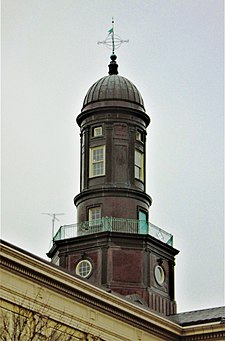
The building'southward steeple (February 2020)
Populations [edit]
The journalist Thelma Berlack Drunkard, a blackness woman, while graduating with Roosevelt's highest average until and then, was the valedictorian of 1924.[47] [48] The Bronx was home, then, more often than not to American whites, whereas Irish were the predominant minority group, while both Italians and Jews were increasing, and blacks were deficient.[49] Having fled dearth in the 19th century and unremarkably worked in America laying railroads,[41] the Irish, the earliest immigrants, dominating the area, frequently harassed Jews,[49] whose families, however, were usually fervent nearly education.[13] Although the Belmont section,[50] Roosevelt's home since 1928, was soon a Lilliputian Italy represented highly in Roosevelt'southward student body,[51] students came from diverse neighborhoods, including the Bronx'southward affluent strip, the Grand Concourse.[51] There, young professionals, mostly Jews, filled the luxury apartment buildings, congenital in the 1920s.[41] [52]
In 1930, holding a master's caste in education from Columbia University, Sarah L Delany, stymied in securing a task in her area of expertise, at last maneuvered to be hired earlier the school's administration had met her.[12] [53] On her commencement day of work, Delany was a shocking sight and awkward presence—a black adult female education at a "white high schoolhouse"—but, already hired through bureaucratic formality, was too difficulty to release.[12] [53] Roosevelt thus became New York City'south first high school to employ a nonwhite teacher of domicile economics.[12] [53] Decades after retiring in 1960, Delany rejoiced, "I spent the residue of my career educational activity at fantabulous high schools!"[12] [53] But by the 1950s, despite big emigration of blacks and Hispanics from the American South and the Caribbean to New York City, members of a local gang, the Fordham Baldies, white, mostly Italian, were menacing these groups in the neighborhood of Roosevelt, whose enrollment remained overwhelmingly white.[14]
Participation [edit]
Focused on adolescence as a menstruation to integrate youth, especially from immigrant populations, into society via high school,[36] American educators emphasized voluntary participation in extracurricular activities.[54] From 1931 to 1947, some 80% of graduates from New York Metropolis high schools had been extracurricularly active, as in sports or clubs.[eleven] Participation was highest, 99%, at Bay Ridge Loftier School, a girls' schoolhouse in Brooklyn, and was lowest, 56%, at Theodore Roosevelt Loftier School.[eleven] Throughout the metropolis, some 75% of blacks participated extracurricularly, simply black boys' prominence only on runway teams may reflect a strong exclusionary bias.[55]
Many parents, specially of recent immigration, wanted their daughters away from male person peers altogether, a cistron commonly of import to Italians, comprising nearly 33% of Bay Ridge High School's students, many of whom commuted from a wide area since parents viewed this girls' high schoolhouse every bit "safety", like a parochial school.[56] Although Brooklyn'southward Bay Ridge section was mainly American white, as were some 25% of the high school's students, faculty may have encouraged universal involvement and prevented spontaneous ethnic segregation, as Italian girls and the few blackness girls akin were extracurricularly involved far more elsewhere, a stark contrast from blackness boys at Roosevelt.[56]
World State of war [edit]
In 1938, while nevertheless a Theodore Roosevelt High School pupil, June Allyson joined the Broadway chorus line Sing Out the News.[57] [34] [58] With World War II's 1939 outbreak, curricula at American public schools were redirected toward the state of war try.[ii] On Oct 8, 1940, vowing to keep America out the state of war, Wendell Willkie, the Republican Party'south presidential candidate for that year's election, gave a oral communication at Theodore Roosevelt High School,[ten] and died that 24-hour interval in 1944. By then, Allyson had become "the apple tree of Hollywood's eye in the war years and everyone'southward notion of the girl next door".[58] Meanwhile, preparing students less for college entrance than for practical jobs, Roosevelt "wasn't a progressive academic institution", and "never was".[xiii]
On a rainy 24-hour interval, October 21, 1944, campaigning for reelection, President Franklin D Roosevelt rode past motorcade through the Bronx tiredly waving,[59] while children in onlooking crowds apprehended a connection to a world outside the Bronx.[60] For many adults, including some who taught at Roosevelt, the 1945 death of President FDR—in the White Business firm a dozen years while leading America through the Great Depression and World War Ii—severed a sense of continuity with the past.[61] In 1947, opposing communism, the Catholic War Veterans of New York defendant the urban center's Lath of Education of aiding subversives by letting the communist group American Youth for Republic hold meetings in Roosevelt's building, which was similarly used by various organizations.[9]
Transformation [edit]
In the 1950s, four friends from the Belmont section, a Piffling Italy in the Bronx,[62] formed Dion and the Belmonts, whose members, lead singer Dion DiMucci, offset tenor Angelo D'Aleo, 2d tenor Fred Milano, and baritone Carlo Mastrangelo, had all been Roosevelt students together.[35]
Meanwhile, during the 1950s, Cleveland Indians baseball histrion Rocky Colavito, born in the Bronx in 1933, inspired Cleveland fans' proverb Don't knock the Rock, seen as "everything a ballplayer should be".[63] A Sporting News article of June 10, 1959, named him the American League player near likely to intermission Babe Ruth's record, lx domicile runs in a season.[63] Still Rocky experienced a slump, and the next year, 1960, was traded to the Detroit Tigers.[63] In 1994, upon sportswriter Terry Pluto'due south "loving tale" of a expletive on the Cleveland franchise ever since, Colavito proclaimed innocence.[34] Yet already, caput had confessed to, he said, "a big error".[63] Nearing 1950, at a tryout at Yankee Stadium, a lookout for Cleveland's small-scale-league team witnessed just one throw by Colavito and recruited him, prompting Colavito's successful petition against the league's rule against signing anyone earlier his high-school form had graduated.[63] Colavito thus dropped out of Roosevelt later on his sophomore year to play semipro baseball game.[63] Colavito later rued, "I didn't want kids to say, 'He dropped out of school and he made the big leagues' ".[63]
In the 1960s, newly hired teacher Alfred Posamentier organized Roosevelt'southward first mathematics teams, merely before long left to join academia and spearhead efforts to improve mathematics teachers' effectiveness.[64] Roosevelt students of the late 1960s included Ace Frehley, afterwards the lead guitarist of Osculation, and Chazz Palminteri,[32] afterwards the actor whose 1988 play A Bronx Tale was partly his own babyhood memoir, based in Belmont.[62] Adapted to a 1993 screenplay,[65] it became Robert De Niro's directing debut. Frehley had attended a private Lutheran school, but, "also wild", was ejected, went to the public DeWitt Clinton High School, "a progressive place" in the Bronx, simply was one of but a couple of students with long pilus, refused to cut it, and was transferred to Roosevelt, where he focused on art courses, got bored, and dropped out, nevertheless returned and graduated.[66] Palminteri, besides, had attended Clinton, but, disliking its being all male person, transferred to Roosevelt, where this poor student, who got girls to practice his homework, graduated in 1973 at historic period 21.[67] Although later actor Jimmie Walker's diploma was from Clinton, he met its requirements in 1965 by attention night classes at Roosevelt,[15] whose summertime sessions, too, taught students of other high schools.[16]
Deterioration: 1970s–80s [edit]
Drug civilisation [edit]
During the 1950s, as Usa government's policy shifted Puerto Rico'southward economy from agronomics to manufacturing, many Puerto Ricans sought sustainable work by emigrating to New York City.[68] Later on similar moves to New York, emigrant blacks from the American South and from the Caribbean area increasingly emerged from poverty, a progress that slowed in the 1960s and halted by most 1970, notwithstanding, among rising stagflation and The states government'due south focus on the Vietnam War.[26]
Previously deficient within American ethnic minority groups, illegal drug selling emerged in the 1960s.[eighteen] Seeking heroin, white gang members began venturing into the neighborhoods of blacks and Puerto Ricans, who, no longer menaced past these whites, increasingly enrolled at Roosevelt,[14] where illegal drug selling became prevalent by the late 1960s.[16] Further, heroin offered young gang members a new masculinity token—heroin usage without habit—while elder gang members, commonly addicted, seeking to diminish police force attention while possessing the narcotic, formed truces.[xiv] Paradoxically, and then, early on drug culture lowered gang violence.[14]
Urban decay [edit]
In the aftermath of New York City government's near bankruptcy in 1975, the city's 1977 blackout triggered massive annexation that bankrupted many stores.[23] Many Bronx neighborhoods, resembling rubble past 1979, went aflame, while apartment buildings were abandoned or else sold to bottom landlords amid astringent, rapid urban decay.[24] [23] [22] [69] The view of schools as a collaborative attempt emphasized agreement amid workers, potentially in the educational bureaucracy for decades, whereas points of central importance in educating adolescents, each in high schoolhouse for but a few years, fell off the calendar, dominated by the lowest common denominator—the adults' widest agreement.[70] While many educational administrators and officials maneuvered to secure school jobs for their own families and friends,[71] the students got insufficient attention.[72] Although it takes a strong leader, perhaps unpopular, to plow schools effectually, voters may lack the attending or involvement to vote accordingly.[70] Dissatisfied parents who have the financial means, and then, simply enroll their children in private schools—or move their families elsewhere.[lxx]
Local problems [edit]
From 1970 to 1980, New York City's population fell from well-nigh eight to a little over 7 million via white flight, while crime, ranging from vandalism to murder, soared, and so, nearly midway through the 1980s, the fissure epidemic struck[18] [22] Bronx loftier schools were reputed as the city'south worst,[25] while Theodore Roosevelt High School signified the degeneration.[30] In 1984, Roosevelt had New York City'south highest dropout rate.[29] In 1986, Roosevelt had a new principal, Paul B Shapiro, and spent an extra $750 thousand—atop its normal budget of $10 million—to raise school omnipresence.[29]
The jurisdiction of the New York City Police Department's 46th Precinct[73]—adjacent due west of the 48th Precinct'southward jurisdiction, which independent Roosevelt High[74]—was notoriously homicidal among New York City's 75 precincts.[27] The zone high school for residents of neighborhoods policed by the 46th Precinct, Roosevelt received those troubles,[75] including police officers who aided drug tracking and menaced residents.[28] In 1989, a airplane pilot plan at Evander Childs High School found metallic detectors at pupil entrances constructive, specially as to guns.[76] Among the New York Metropolis schools accounted most violent, Roosevelt was amongst the first dozen more than to get metal detectors.[76] New York City's homicide count peaked in 1990.[77]
Internal dilemmas [edit]
Some students figured out how to sneak metal weapons past Roosevelt'due south metallic detectors,[78] while other Roosevelt students sustained threats riding public transportation to schoolhouse.[79] Local gang members posed the specter of random slashings for gang initiations.[75] Versus many other high schools' students, Roosevelt's had been more greatly beset by the specter of AIDS.[80] Allegedly, all of Roosevelt's students lived beneath the poverty line.[31] Near one in three Roosevelt students, speaking English every bit a 2d linguistic communication, needed help learning English.[81] Or a student could enter Roosevelt unable to read, and, once at that place, presently cease attending.[79]
Some students kept attention, but barely did schoolwork.[82] Oft failing to graduate in four years, or fifty-fifty in v years as "superseniors", some became "ultraseniors", peradventure yet students at age 21,[82] when nongraduating students would exist dropped by the schoolhouse system.[32] Amidst New York state's worst schools, Roosevelt was placed on the New York Country Department of Education'south list of declining schools.[82] And yet New York City's educational bureaucracy—the seven appointed members of the NYC Board of Teaching, its hired chancellor of schools, the 32 school districts' 32 elected school boards, and the 32 school districts' 32 hired superintendents[83]—shielded anyone from blame for the deterioration.[84]
Rejuvenation: 1990s [edit]
Vigorous leadership [edit]
In 1992, Thelma B Baxter—whose mother had been Roosevelt'southward valedictorian in 1923[85]—became Roosevelt's main.[31] Baxter extended grade hours, and ensured that students retained the same teacher in a bailiwick for both semesters during a school year.[31] Though finding "100 percent" of the students poor,[82] she found parents' bug no excuse for staff allowing students to do poorly.[85] Despite having "basically the aforementioned school", Baxter ensured that they "put tougher standards in place".[86] Though Baxter was "pugnacious" like the school's namesake,[82] students often stopped by her role to talk, seek communication, or encompass,[87] and Baxter frequently walked the halls while accosting students, newly prohibited from wearing hats within the building. In a 4-year span, Roosevelt students taking the math Regents exam rose from some 200 to over 500.[87]
In January 1996, after 3 years of rising attendance, exam scores, and graduation charge per unit, Theodore Roosevelt High Schoolhouse left the land education department'due south list of failing schools,[88] and Baxter was the subject of a New York Times editorial.[31] During the next two years, the suspension rate fell some 50%.[87] In September 1997, Baxter had begun "moral and efficacy" seminars where freshmen were shown videos and discussed issues of school attendance and right versus wrong.[82] Roosevelt also began a "Saturday Establish" where some 500 heart-schoolhouse students and their parents attended workshops and tutoring to aid fix for high school.[82] At Mayor Rudy Giuliani's 1998 initiative to push students in loftier school beyond 5 years into dark or weekend schools, Baxter pointed out the item challenges that her students face—such as language barriers and parents returning with them to the Caribbean for significant periods—and asserted that she preferred to proceed underperforming students in a "caring atmosphere".[82]
Expanding partnerships [edit]
In the early on 1990s, Williams Higher, often ranked America's all-time liberal arts college, began an substitution program with Roosevelt.[89] Taken from Roosevelt'south honors programme, and chaperoned by English instructor Frank Dark-brown, select students periodically visited the Williams campus, and, demonstrating delivery to the program, then graduating from Roosevelt, received full scholarships to Williams. In 1998, the same English instructor, Frank Brown, simultaneously the soccer coach, led the Roosevelt team against Martin Luther King High School in the championship game.[ninety] During information technology, Roosevelt learned and immediately alerted the governing bureau that two of King'south star players were ineligible, having played in Nigeria besides many high-school seasons.[xc] [91] After the game, omnibus Chocolate-brown and main Baxter sought not the 1998 boys soccer title, only merely its revocation from King.[90] [91] Although acknowledging the two King players' ineligibility, the Lath of Didactics denied Roosevelt's petition, every bit did the city's public schools' athletic governing bureau, which maintained that petitions must be filed before a game.[92] Upon finding Roosevelt's representatives accused of pettiness in a New York newspaper, Brownish asserted Roosevelt'southward stance to instead exist principled.[91]
In September 1998, to implement at Roosevelt an afterschool plan, The Afterward-Schoolhouse Corporation granted $200 g to Phipps Houses,[93] which in turn hired singer Russell Glover, in one case of the Boys Choir of Harlem, to create and direct the programme: Superior Try Afterschool Liberates (SEAL).[94] From 3pm to 5pm, SEAL included 14 activities involving some 400 of Roosevelt'southward roughly 4000 students.[93] [94] The highlight, patently inspired by Las Vegas and hip hop, was the "Russell Glover Show", three hours long, a revue—including break dancing, way show, gymnastics, karate, singing, and other performances, more often than not past SEAL participants—that by April 1999, its fourth show, held in Roosevelt's gymnasium, drew a crowd of some m Roosevelt students.[94] A ninth grader remarked, "This show gets kids motivated. It gives you the idea that y'all can exercise something with your life".[94] Finding "crossover value" in SEAL activities, Baxter commented, "To gear up to be academically successful, kids need to develop their bodies and minds".[93] Actually, Glover generally prepared students for task training or task hunting.[93] During Baxter's bridge at Roosevelt, its community partnerships rose from four to 30.[87] Although Roosevelt yet lagged behind other New York City loftier schools,[32] [93] Roosevelt'southward rapid turnaround brought Baxter a citywide acclaim, and so a national acclaim.[31] [95]
Termination: 2000s [edit]
Giuliani mayorship [edit]
On November eight, 1995, some 900 people, mostly parents, gathered for about two hours in the Roosevelt building.[96] That evening, Rudy Coiffure, the newly appointed chancellor of New York City's public schools, gave the first of a series of talks, in all 5 urban center boroughs, about Crew'south vision for the school system, which covered just over a million students.[96] Crew vowed that his chancellorship would be "about children kickoff, foremost, finally, and forever".[97] Meanwhile, amid reports of school problems or bureaucratic corruption or incompetence, New York Metropolis's mayor, Rudy Giuliani, would scorn the city'due south Lath of Education.[98] Giuliani once added, "This is why control of schools should be given to the mayor".[98] In 1999, while several cities, including Boston, Chicago, and Cleveland, had given mayors, in fact, more control over schools, Mayor Giuliani, during that year'due south upkeep speech, instead lamented, "The whole system should exist blown up".[98]
In the summer of 1999, Chancellor Coiffure canonical the engagement of Roosevelt's principal Thelma Baxter to a new position, the superintendent of School District 5,[99] located in central Harlem.[85] [100] [101] Seeking to mimic and aggrandize her Roosevelt successes, Baxter left Roosevelt.[87] The side by side year, in 2000, the New York State Department of Education's list of failing schools reclaimed Roosevelt, graduating 33% of its students in their fourth years, versus the citywide boilerplate of 50%.[32] In 2001, the department ordered the school, besides considered violent, to begin shutdown.[32] The final freshman class, entering in 2002, would yield the Theodore Roosevelt High School'south final graduating form in 2006.[32] While several small high schools opened within the four-story edifice, Roosevelt High occupied only the first and fourth floors, and yet hosted about double the citywide average of reported incidents, ranging from loitering to felony assault.[32]
Bloomberg mayorship [edit]
In January 2004, deeming the city'south Department of Education likewise nonchalant, Mayor Michael Bloomberg asserted responsibility for the urban center's more often than not underperforming public schools.[84] Further, he announced that some, newly identified as "impact" schools, would go extra police presence.[84] That month, a riot in the interruption center at Roosevelt prompted pressure to put Roosevelt on the metropolis's listing of schools called the "Dangerous Dozen".[102] During that month, Roosevelt would sustain 110 "criminal and hell-raising incidents",[103] although information technology ofttimes went unmentioned that many of them, although within Roosevelt, had been committed by other schools' students, not by Roosevelt's students.[32] The violence in Roosevelt, having before fallen,[102] resurged in one case the metropolis'due south Department of Instruction placed on the fourth flooring of Roosevelt's edifice the suspension center, intended for upwardly to xx students suspended from various Bronx high schools for infractions ranging from vandalism to striking teachers, and all the same reduced the number of security staff available there.[104]
In Apr 2004, or iii months after the riot, Mayor Bloomberg announced the addition of four schools, including Roosevelt, to the listing of "touch" schools, particularly trigger-happy, to become actress police presence.[103] In June 2005, with Roosevelt's enrollment down to virtually 1 500 students and its building newly housing several pocket-size schools,[32] Mayor Bloomberg visited Roosevelt to announce, before news media, that six schools, including Roosevelt, treated in the "impact" program had shown sharp falls in crime.[105] Others, too, found Roosevelt'southward building calmer.[106] In the past yr, misdemeanor assaults brutal from 13 to half dozen, felony assaults from 5 to one, and sexual assaults from 3 to 0.[105] Meanwhile, the modest-schools motility gained Bloomberg'due south favor.[32] Widely troubled, the city's large loftier schools sustained widespread shutdowns.[30] On June 30, 2006, Roosevelt's concluding grade graduated at the lowest charge per unit among the city'due south big loftier schools, 3%.[33] The Theodore Roosevelt High School then closed.[30] [107] (Its building was renamed the Theodore Roosevelt Educational Campus, housing six modest loftier schools: the Belmont Preparatory High School, the Bronx High School for Law and Community Service, the Fordham High Schoolhouse for the Arts, the Fordham Leadership Academy for Business and Technology, the West Bronx Academy for the Futurity, and the Knowledge and Power Preparatory Academy.)[4]
Notable alumni [edit]
- June Allyson (1917-2006), was an American phase, picture, and television actress, dancer, and vocalist.
- Dion and the Belmonts, American vocal grouping of the late 1950s. Dion DiMucci, Carlo Mastrangelo, Fred Milano are all Roosevelt students.
- Thelma Berlack Boozer (1906-2001), a leader in feminists movement and African-American in announcer, publicist, and city official in New York.
- Rocky Colavito (1933-), old Major League Baseball All-Star player, who is best known playing for the Cleveland Indians
- Ace Frehley (1951-), American musician and songwriter best known as the original pb guitarist and co-founding fellow member of the rock band Kiss (attended the school, just did non graduate)
- John Garfield (1913-1952), was an American thespian
- Sammy Mejía (1983-), Dominican American retired professional person basketball game actor
- French Montana (b 1984), is a Moroccan-American rapper.
- Ben Oglivie (1949-), Panamanian-American retired professional baseball player; outset non-American-born player to lead the American League in home runs (1980)
- Chazz Palminteri (1952-), American actor, screenwriter, producer and playwright
- Jimmie Walker (1947-), American actor and comedian attending dark classes at Roosevelt.
References [edit]
- ^ Morris High School and Evander Childs Loftier School had opened kickoff.
- ^ a b c d Lisa Rogak, A Boy Named Shel: The Life and Times of Shel Silverstein (New York: Thomas Dunne Books, 2007), p 9: "When World War 2 bankrupt out in 1939, the curriculum at public schools beyond the country was retooled toward the war. Teaching basic military skills was the rule when Shel entered Theodore Roosevelt Loftier School in September 1944. The loftier school was i of the largest in the nation, covering ii city blocks, and was one of the all-time equipped as well. Its capacity was simply over iv 1000 students and independent ninety classrooms and a variety of sewing rooms, music rooms, auto shops, 3 woodworking shops, scientific discipline laboratories, gymnasiums, swimming pools, auditoriums, and a cafeteria that could seat i thou".
- ^ In February 2015, a two-year reconstruction project began on the building'south exterior, affected by aging cement and falling bricks.
- ^ a b Clara Hemphill, "Theodore Roosevelt Educational Campus", Insideschools, Mar 2012:
- Belmont Preparatory High Schoolhouse
- Bronx Loftier School for Law and Community Service
- Fordham High School for the Arts
- Fordham Leadership Academy for Business concern and Applied science
- KAPPA International High School
- West Bronx Academy for the Futurity
- ^ a b Norval White & Elliot Willensky w/ Fran Leadon, AIA Guide to New York City, 5th edn (New York: Oxford University Printing, 2010), entry "W1", p 846.
- ^ a b c d e f g h i "The Roosevelt High Schoolhouse: Just a piffling over a year erstwhile and overcrowded", School (New York, NY), 1920 Jan 22;31(21):197,202, p 197.
- ^ a b c d Bronx Board of Merchandise, The Bronx: New York City's Fastest Growing Borough (Bronx NY: Bronx Lath of Merchandise, 1922), p 3.
- ^ a b Elsie B Goldsmith, "Schedule of schools: ane: Commercial education", pp 2–21, Directory of Opportunities for Vocational Grooming in New York City (New York: Vocational Service for Juniors, 1922), p sixteen.
- ^ a b Clarence Taylor, Reds at the Blackboard: Communism, Civil Rights, and the New York City Teachers Wedlock (New York: Columbia University Press, 2011), p 158.
- ^ a b Susan Dunn, 1940: FDR, Willkie, Lindbergh, Hitler—the Election Amid the Storm (New Haven CT: Yale University Press, 2013), pp 1 & 202–203.
- ^ a b c Paula S Fass, Children of a New World: Society, Civilization, and Globalization (New York & London: New York University Press, 2006), p 76.
- ^ a b c d due east Lloyd Ultan & Barbara Unger, Bronx Emphasis: A Literary and Pictorial History of the Borough (Piscataway NJ: Rutgers Academy Press, 2000), pp 107–108, including quote from p 108: "Child, when I showed up that day—at Theodore Roosevelt High School, a white loftier school—they simply virtually died when they saw me. A colored woman! But my proper noun was on the list to teach in that location, and it was too late for them to send me someplace else. The plan had worked! Once I was in, they couldn't figure out how to get rid of me. So I became the starting time colored teacher in the New York Urban center system to teach domestic science on the high school level. I spent the rest of my career educational activity at excellent high schools! Betwixt 1930 and 1960, when I retired, I thought at Theodore Roosevelt High School, which is on Fordham Road in the Bronx, and so at Girls' High School in Brooklyn, and finally at Evander Childs High Schoolhouse, which is on Gun Loma Road in the Bronx".
- ^ a b c Harold Thau due west/ Arthur Tobier, Bronx to Broadway: A Life in Prove Business (New York: Applause Theater & Cinema Books, 2002), pp 32–33: "It wasn't until my male parent's business went into financial hemorrhage and all the help had to be let become that I got a shut expect at the downside of gratuitous enterprise. ... Every night for a yr, with the meager receipts of the evening in a brown paper bag, I closed the door on a failing business and rode a cab up to the Bronx, request myself: What could I do to help? How could I make a deviation? I really didn't have the answers. No one seemed to have them. ... For a long time, a shroud of gloom lay over my soul. Theodore Roosevelt High Schoolhouse didn't help me much in this regard. Information technology wasn't a progressive academic establishment; it never was. The governing idea at that place was, 'Get these boys and girls out into the world and into jobs that'll let them to survive'. But I ever knew I could survive: information technology was more than a job that I wanted. Besides, there was never a question in my mind that I wouldn't exist going to higher. I always felt, any else was going on, my parents would find a mode for me to go. That was simply my frame of reference. Few of my friends thought otherwise. In the East Bronx, Jews as a group had an almost religious fervor most educating their children". (A search of the book, on Google Books, using the term born leaves elusive Thau'south birth year. Withal page 28 shows a photo and caption, viewable via Amazon.com'due south Await Inside characteristic, that put his bar mitzvah in 1947. This suggests the historic period xiv, presumably starting high school, in 1948.)
- ^ a b c d eastward f g Eric C Schneider, Vampires, Dragons, and Egyptian Kings: Youth Gangs in Postwar New York (Princeton & Oxfordshire: Princeton University Press, 1999), p 184.
- ^ a b Jimmie Walker westward/ Sal Manna, Dyn-O-Mite!: Good Times, Bad Times, Our Times—A Memoir (Philadelphia: Da Capo Press, 2012), p 22.
- ^ a b c d Allen Jones w/ Mark Naison, ch 17 "Shifting loyalties", pp 83–87, The Rat that Got Away: A Bronx Memoir (New York: Fordham University Press, 2009): pp 83–85 discuss local youth subculture around 1967, while pp 86–87 illustrate it in events involving T Roosevelt HS.
- ^ Amid economic stagnation—that is, floundering industry, rising unemployment, and stalling pay raises—prices of products and services were ascent, inflation.
- ^ a b c Eloise Dunlap & Bruce D Johnson, "The setting for the crack era: Macro forces, micro consequences (1960–1992)", pp 45–59, in Marilyn D McShane & Franklin P Williams III , eds, Drug Utilise and Drug Policy (New York & London: Garland Publishing, 1997), pp 53–54.
- ^ Jeff Nussbaum, "The dark New York saved itself from bankruptcy", The New Yorker magazine website, Condé Nast, xvi Oct 2015.
- ^ Businesses typical of wholesome communities closed or moved, belongings value fell, and most flat buildings either were burned and abandoned, how their reputable landlords may collect insurance bounty, or were sold to thrifty or miserly landlords.
- ^ Composed mainly of American whites, including Jews, the gentrified classes fled.
- ^ a b c Christina Sterbenz, "New York Urban center used to exist a terrifying place", Business Insider, 12 Jul 2013.
- ^ a b c Rodney P Carlisle, Handbook to Life in America, Book IX: Contemporary America, 1970 to the Nowadays (New York: Facts On File, 2009), pp 68–70.
- ^ a b David Gonzalez, "Faces in the rubble", New York Times, 21 Aug 2009.
- ^ a b John N Gardner & Betsy O Barefoot, ch x "Lehman Higher of the City Academy of New York", pp 219–42, in Betsy O Barefoot et al, eds, Achieving and Sustaining Institutional Excellence for the Offset Year of College (San Francisco: Jossey–Bass, 2005), p 219.
- ^ a b Eloise Dunlap & Bruce D Johnson, "The setting for the crack era: Macro forces, micro consequences (1960–1992)", pp 45–59, in Marilyn D McShane & Franklin P Williams Three , eds, Drug Utilise and Drug Policy (New York & London: Garland Publishing, 1997), pp 49–50.
- ^ a b "46th Precinct", Official New York City Law Department Spider web Site, visited x Mar 2014: the 46th Precinct polices the Bronx sections Mount Hope, Morris Heights, University Heights, and Fordham Heights. For a closer word, see Graham Rayman, The NYPD Tapes: A Shocking Story of Cops, Cover-ups, and Backbone (New York: Palgrave Macmillan, 2013), pp 62–64. For a contemporary source, see John T McQuiston, "Four slain in vehement Bronx area", New York Times, 29 Sept 1987, reporting, in part, "Iv residents were slain in separate incidents in one South Bronx precinct during a 15-60 minutes period that concluded early yesterday afternoon, the police force said. The slayings occurred in the 46th Precinct, north of the Cross Bronx State highway in Morris Heights, where it is not unheard of to take iv homicides in a day, according to Sgt. Benjamin Dowling, a precinct spokesman. There was an boilerplate of 4.3 murders a twenty-four hours terminal year in all of New York City, which is divided into 75 precincts. 'We're very heavy into homicides in this precinct,' said Sergeant Dowling".
- ^ a b Leonard Levitt, NYPD Confidential: Power and Corruption in the Country's Greatest Police Force (New York: Thomas Dunne Books, 2009), pp 155–56. In gimmicky journalism, Craig Wolff, "Tales of law corruption non surprising, 46th Precinct residents say", New York Metropolis, 10 Oct 1993, reported, in part, "The 46th Precinct is in the Fordham section of the Bronx. It is a crime-ridden precinct where, the Mollen Commission was told, some of the department'south worst officers were ordinarily 'dumped.' And it is where 'the Mechanic' worked, a convicted officer who earned the nickname for the tune-ups,' or beatings, he performed on drug suspects and innocent bystanders alike. The Police Department says there is no policy of using any precinct, including the 46th, as a place of exile for troublesome officers". Yet under ii years later, Clifford Krauss, "Police officer bedevilled of extorting payoffs", New York Times, 21 Apr 1995, reported that perhaps some 30 officers in the 46th Precinct were involved in various criminal action in the community. And soon, Clifford Krauss, "16 officers indicted in a design of brutality in a Bronx precinct", New York Times, four May 1995, § B, p 1, reported endemic criminality in the 48th Precinct, policing the Belmont section.
- ^ a b c d Jane Perlez, "City'due south schools seek solutions on dropouts", New York Times, 28 November 1986.
- ^ a b c d e f g Mark Coultan, "Weak schools caned where winning counts", Sydney Morning time Herald, xv Nov 2006: "And they don't only name aircraft carriers afterward their presidents. There'southward the Franklin Delano Roosevelt High School, and the Eleanor Roosevelt Loftier School. However, the Theodore Roosevelt High School closed this year. But at that place's a story to that. Theodore Roosevelt High, in the southward Bronx, opened in 1919 and as the expanse descended into drug-fuelled despair, so did the school. An energetic principal, Thelma Baxter, revived the schoolhouse in the 1990s but after she was promoted the school went downhill once again. Schools are reflective of society, and America loves winners. Losers? Nobody wants to know. In Australia, struggling schools get extra assist; in America, it's the best schools that get the money. The worst are told to improve, or close. The principals and teachers detect new jobs, and the children are institute new schools. Often 3 new schools occupy the same building".
- ^ a b c d e f Editor, "Cloning Thelma Baxter", New York Times, 27 Jan 1996.
- ^ a b c d e f g h i j chiliad l Catherine Shu, "A Due south Bronx high school's long goodbye: Phasing out an fourscore-year-old establishment", Columbia Journalism News: Youth Matters, Columbia University Graduate School of Journalism, 2005.
- ^ a b Kenneth Lovett, "Grad Tidings", New York Post, 26 Apr 2007.
- ^ a b c "Theodore Roosevelt High School, Bronx, NY", NNDB, Soylent Communications, 2013, Website accessed 3 Jul 2014.
- ^ a b Bruce Elder, "The Belmonts", AllMusic website, accessed 9 Dec 2019.
- ^ a b c d Paula South Fass, "Creating new identifies: Youth and ethnicity in New York Urban center high schools in the 1930s and 1940s", pp 95–117, in Joe Austin & Michael N Willard, eds, Generations of Youth: Youth Cultures and History in Twentieth-century America (New York & London: New York University Press, 1998), p 95.
- ^ Homer Fifty Patterson, ed, Patterson's American Teaching, Volume fourteen: Higher and School Directory (Chicago: American Educational Company, 1922), p 334.
- ^ a b New York Superintendent of Schools, Twenty-tertiary & Twenty-4th Annual Reports of the Superintendent of Schools, 1920–1922: Loftier Schools (New York: Lath of Education, 1923), p 22: "It appears that The Bronx should have another high school to carry a general and a commercial grade like the Evander Childs High School, to relieve both the Morris and Evander Childs Loftier Schools. The Theodore Roosevelt High Schoolhouse has a register of 1,461 boys and girls in the commercial course. The building in P.S. 31 carries a double session. The schoolhouse has an annex in P.Due south. 47".
- ^ "Evander Childs High School", School: Devoted to the Public Schools and Educational Interests, 1918 Sep 12;thirty(2):nine.
- ^ David Hartman & Barry Lewis, "History: Nascence of a borough", A Walk Through The Bronx, Thirteen/WNET website, Educational Broadcasting Corporation, 2005, accessed 15 Mar 2014: "In 1923, Yankee Stadium was opened at 161st Street and River Avenue equally the dwelling of the New York Yankees, who became known at the 'Bronx Bombers' considering of the large number of habitation runs hit in the following decades by such players every bit Babe Ruth, Lou Gehrig, Joe DiMaggio, Mickey Drape, Roger Maris, and Reggie Jackson".
- ^ a b c d e Constance Rosenblum, Boulevard of Dreams: Heady Times, Heartbreak, and Hope forth the Grand Concourse in the Bronx (New York & London: New York University Press, 2009), pp 46–47.
- ^ a b c Bill Twomey & Thomas X Casey, Images of America: Northwest Bronx (Charleston SC: Arcadia Publishing, 2011), Fordham University buildings shown on pp ix–thirteen & Bronx trolleys shown on pp 14–17.
- ^ David Hartman & Barry Lewis, "History: Birth of a borough", A Walk Through The Bronx, Xiii/WNET website, Educational Broadcasting Corporation, 2005, accessed 15 Mar 2014: "In 1904, the starting time subway connecting the Bronx to Manhattan was built under 149th Street, providing cheap rapid transit that with the 3rd Artery elevated line persuaded hundreds of thousands during the first third of the twentieth century to leave tenements in Manhattan for spacious new apartments in the Bronx. Yugoslavians, Armenians, and Italians were amid those who made the move, but the largest group was Jews from central and eastern Europe. With the influx of population in the first third of the century the economy of the Bronx grew chop-chop. The 3rd Avenue elevated line was gradually extended northward and in the procedure trolley lines were connected to information technology, forming a rapid transit line that provided admission from lower Manhattan to expanses of undeveloped country. Many flat buildings and commercial buildings were presently erected forth the corridor of the elevated line, which reached its northern terminus at Gun Hill Road in 1920".
- ^ a b c d Lloyd Ultan & Barbara Unger, Bronx Accent: A Literary and Pictorial History of the Civic (Piscataway NJ: Rutgers Academy Press, 2000), p 106.
- ^ Evelyn Gonzalez, The Bronx (New York & Chichester: Columbia University Press, 2004), pp 94–96.
- ^ Martin Dunford & Jack Holland, The Rough Guide to New York City (London: Rough Guides, 2002), p 269.
- ^ 5. P. Franklin, "Thelma Berlack Boozer (1906–)", in Jessie Carney Smith, ed, Notable Black American Women, Book Ii (Detroit: Gale Research Inc., 1996), p 39.
- ^ "Child labor article wins high school 'Biggest News' prize", The American Child (National Child Labor Committee), 1924;6(4):iv.
- ^ a b Paula S Fass, "Creating new identifies: Youth and ethnicity in New York City high schools in the 1930s and 1940s", pp 95–117, in Joe Austin & Michael N Willard, eds, Generations of Youth: Youth Cultures and History in Twentieth-century America (New York & London: New York University Press, 1998), pp 109–111.
- ^ Steven G Kellman, Redemption: The Life of Henry Roth (New York: W. Westward. Norton & Visitor, 2005), p 188.
- ^ a b Isabelle Stamler, Sarah'southward Ten Fingers (Bloomington IN: iUniverse, 2012), p 208.
- ^ Constance Rosenblum, "Thou, wasn't it", New York Times, xx Aug 2009.
- ^ a b c d Richard Harmond & Peter Wallenstein, "Delany, Bessie and Sadie Delany", pp 224–225, in Henry L Gates Jr & Evelyn B Higginbotham, eds, African American Lives (New York: Oxford University Press, 2004).
- ^ Paula Due south Fass, "Creating new identifies", pp 95–117, in J Austin & Thousand N Willard, eds, Generations of Youth (New York & London: NYU Press, 1998), p 96.
- ^ Paula S Fass, Children of a New World: Society, Civilization, and Globalization (New York & London: New York University Press, 2006), pp 77–78.
- ^ a b Paula S Fass, "Creating new identifies: Youth and ethnicity in New York Metropolis high schools in the 1930s and 1940s", pp 95–117, in Joe Austin & Michael N Willard, eds, Generations of Youth: Youth Cultures and History in Twentieth-century America (New York & London: New York University Press, 1998), pp 110–111 & 117.
- ^ Lloyd Ultan & Shelley Olson, The Bronx: The Ultimate Guide to New York City's Cute Civic (New Brunswich, NJ: Rutgers University Press, 2015), p 152.
- ^ a b Obituary, "June Allyson", The Telegraph (U.k.), 12 Jul 2006.
- ^ David Chiliad Hashemite kingdom of jordan, FDR, Dewey, and the Election of 1944 (Bloomington IN: Indiana University Press, 2011), p 272.
- ^ Harold Thau w/ Arthur Tobier, Bronx to Broadway: A Life in Prove Business organisation (New York: Applause Theater & Cinema Books, 2002), pp five–vii.
- ^ Madeline B Stern & Leona Rostenberg, Old Books, Rare Friends: 2 Literary Sleuths and Their Shared Passion (New York: Doubleday, 1997), pp 60 & 150.
- ^ a b Jeff Vandam, "The bigger Trivial Italy", New York Times, 5 February 2010.
- ^ a b c d e f yard Joseph Wancho, "Rocky Colavito", Society for American Baseball Enquiry website, accessed three Jul 2014:
"Rocky attended Theodore Roosevelt High Schoolhouse, but dropped out after his sophomore twelvemonth to play semipro baseball, hoping that would atomic number 82 to a more than direct road to his dream of playing major league baseball. 'Information technology was a large mistake', Colavito recalled. 'I didn't want kids to say, "He dropped out of schoolhouse and he made the large leagues".' Baseball, though, prohibited a role player from signing a professional contract until his grade graduated. However, Commissioner Happy Chandler made an exception for Colavito, who had appealed the ruling, and Rocky was allowed to sign a contract at age 17."
"In 1994, Cleveland sportswriter Terry Pluto wrote a best selling volume entitled The Expletive of Rocky Colavito. In it, Pluto details the trials and tribulations of the Cleveland franchise after Frank Lane traded Colavito to Detroit. Pluto, who was built-in in 1955, recalls that the first words he may have learned were 'Don't Knock the Rock'. He picked up the phrase from his male parent when he was quite young, as did about Tribe fans of that generation. Pluto describes the Cleveland fans' admiration for Colavito thus: 'He was everything a ballplayer should be: nighttime, handsome eyes, and a raw-boned build—and he striking home runs at a remarkable rate' ". - ^ Alfred S Posamentier, Terri 50 Germain-Williams & Daniel Jaye, What Successful Math Teachers Do, Grades six–12, 2nd edn (Thousand Oaks CA: Corwin Press, 2013), p xvi.
- ^ Marianne Garvey, "Lillo Brancato of 'Bronx Tale' wants to show Chazz Palminteri he's inverse since prison", New York Daily News, 7 Mar 2014, quotes the movie'southward lead histrion, Lillo Brancato: "He wrote a beautiful story about his life and I was chosen past him and De Niro to play the lead in that beautiful story, which is an opportunity of a lifetime".
- ^ David Leaf & Ken Abrupt, KISS: Behind the Mask—Official Authorized Biography (New York: Hachette Book Grouping, 2003/2005), indexing "Roosevelt".
- ^ "Chazz Palminteri", § "Early on life", Biography Aqueduct website, accessed March 15, 2014: "Palminteri originally attended DeWitt Clinton Loftier School, just transferred to Theodore Roosevelt High School because he did not like the all-boys surround at DeWitt Clinton. Despite existence a poor student—'I would brand girls practise my homework,' he recalls—Palminteri graduated from Roosevelt High in 1973 and immediately prepare out to brand it as an role player".
- ^ Carmen I Mercado, "A lifelong quest for biliteracy: A personal and professional journey", pp 36–48, in María de la Luz Reyes, ed, Words Were All We Had: Becoming Biliterate Against the Odds (New York: Teachers College Press, 2011), p 37.
- ^ See History of New York Metropolis (1978–nowadays) for expanded discussion of urban disuse in New York City from the 1970s to 1980s.
- ^ a b c Joe Williams, Cheating Our Kids: How Politics and Greed Ruin Education (New York: Palgrave MacMillan, 2005), p 166, including this quote: "If we've learned anything in the years since the federal government produced A Nation at Risk, a call to arms almost the demand to radically modify the style we deliver education in America, it's that things don't modify in our school systems unless strong—and sometimes unpopular—leaders make them change. Even and so, information technology is hard to proper noun many school systems that have managed to change the culture of the arrangement. Few have been able to free themselves from the notion that public schoolhouse systems operate as somewhat collaborative efforts".
- ^ In the late 1980s, 11 of the metropolis'due south 32 elected school boards had been under split up investigations for abuse, according to Joe Williams, Cheating Our Kids (N Y: Palgrave MacMillan, 2005), p 170.
- ^ Joe Williams, Cheating Our Kids: How Politics and Greed Ruin Instruction (New York: Palgrave MacMillan, 2005), pp 169–170.
- ^ "46th Precinct", Official New York City Police Section Web Site, accessed ten Mar 2014: the 46th Precinct polices the Bronx sections Mount Promise, Morris Heights, University Heights, and Fordham Heights.
- ^ "Precinct Maps: Precinct Finder", Official New York City Constabulary Department Web Site, accessed viii Mar 2014.
- ^ a b Bob Kappstatter & John Marzulli, "Bloods, dread and fear shake city", New York Daily News, eleven October 1997.
- ^ a b Neil A Lewis, "Metallic detectors accounted success and will expand in schools", New York Times, 6 Sep 1989.
- ^ "There were 120 murders reported so far in 2014 compared with 140 a year earlier, a 15 pct decline, the information indicated", "the city on track to prepare a new low afterward posting a full of 333 murders final yr, the fewest homicides recorded in citywide criminal offense statistics dating dorsum to 1963", although "New York long struggled with high crime rates, most notably in the early 1990s when more two,200 people were murdered in some years" [Victoria Cavaliere, "Even every bit shootings rise, murder charge per unit falls in New York Metropolis", Reuters, x Jun 2014]. New York City recorded 1814 homicides in 1980, and recorded 2241 in 1990 [Christina Sterbenz, "New York Metropolis used to be a terrifying place", Business organisation Insider, 12 Jul 2013]. An historical chart depicts the trends [Ritchie King, "Annual homicides in New York City", Quartz, 31 Dec 2013].
- ^ Leighton C Whitaker, Understanding and Preventing Violence: The Psychology of Human Destructiveness (Boca Raton FL: CRC Printing, 2000), p 35.
- ^ a b Beth Fertig, Why deceit U teach me 2 read?: Three Students and a Mayor Put Our Schools to the Examination (New York: Farrar, Straus and Giroux, 2009), p viii.
- ^ Joseph Berger, "Condoms in schools", New York Times, 22 Dec 1990.
- ^ Maria Newman, "Students teaching teachers; immigrants reverse language-skill roles in Bronx school", New York Times, xvi Apr 1992.
- ^ a b c d e f g h Randal C Archibold, "At Bronx school, 'ultra-seniors' ponder graduation", New York Times, 19 Jan 1998.
- ^ NYC'southward Board of Education had seven members—v each appointed by ane of the five civic presidents, and two appointed by the NYC mayor—who voted on broad policies and vendor contracts, hired the chancellor, and every five years approved a construction plan of several billion dollars. Each of the 32 school districts had an elected school board overseeing district policies and strongly influencing hiring of that district'south superintendent. All the same, for example, Queens schools were overcrowded, whereas Staten Island'due south had room to spare, although "fairness" compelled the city's Board of Education to classify structure money equally for each borough, thus balancing concerns of the civic presidents, non needs of the schoolchildren. Joe Williams, Cheating Our Kids (N Y: Palgrave MacMillan, 2005), p 170.
- ^ a b c Joe Williams, Adulterous Our Kids: How Politics and Greed Ruin Education (New York: Palgrave MacMillan, 2005), p 168.
- ^ a b c "Crew's brigade to help failing schools", New York Daily News, 8 Sep 1999.
- ^ New York School Boards, 1996;two:15: "Chief Thelma Baxter's explanation for the dramatic turnaround of Theodore Roosevelt High School in the Bronx, which was just removed from the state's list of declining schools, offers a valuable lesson. 'We are here with basically the same schoolhouse', Baxter said. 'Simply nosotros accept put tougher standards in place'".
- ^ a b c d due east Raphael Sugarman, "District main has big hopes of repeating by successes", New York Daily News, September 21, 1999.
- ^ Jeff Simmons, "Flunking schools make class", New York Daily News, 23 Jan 1996.
- ^ "Williams, MCLA announce teaching programme", The Williams Tape, 22 Sep 1998: "For the past several years Williams has besides had a cooperative program with Mt Greylock Regional High School and Theodore Roosevelt High School in the Bronx. The program involves educatee and faculty exchanges between the two high schools and pupil pedagogy opportunities at Roosevelt for Williams students during Winter Study".
- ^ a b c Julian Garcia, "Roosevelt will appeal MLK ruling", New York Daily News, xv Dec 1998.
- ^ a b c Frank Brown, Letter to the editor: "Petty or principled?", New York Times, 4 April 1999.
- ^ Julian Garcia, "MLK keeps crown", New York Daily News, 29 Jan 1999.
- ^ a b c d east Randal C Archibold, "In school; to improve learning and omnipresence, schools are drumming upwardly involvement in after-school programs", New York Times, 24 Mar 1999.
- ^ a b c d Raphael Sugarman, "Hip hop-inspired show a groove for students", New York Daily News, 8 April 1999.
- ^ Thomas L Good, ed, 21st Century Pedagogy: A Reference Handbook, second edn (Thou Oaks CA: Sage Publications, 2008), p xix.
- ^ a b Joe Williams, Cheating Our Kids: How Politics and Greed Ruin Education (New York: Palgrave MacMillan, 2005), p 169.
- ^ Joe Williams, Cheating Our Kids (N Y: Palgrave MacMillan, 2005), p 170.
- ^ a b c Joe Williams, Cheating Our Kids (North Y: Palgrave MacMillan, 2005), pp 170–171.
- ^ "District 5", Insideschools, website accessed 17 Mar 2014.
- ^ Randal C Archibold, "Chancellor names new superintendents for ailing schools", New York Times, 13 Aug 1999.
- ^ Howard Schwach, "School scope", The Wave, 17 Jul 1999.
- ^ a b Celeste Katz, "Bx anarchism HS may bring together list", New York Daily News, 24 Jan 2004.
- ^ a b Elisa Gootman, "4 high schools added to those that crave extra security", New York Times, 16 Apr 2004.
- ^ Elissa Gootman, "Principals say bad planning contributed to violence", New York Times, 24 January 2004.
- ^ a b David M Herszenhorn, "Crime is down in half dozen schools on city's most-troubled list", New York Times, 23 Jun 2005.
- ^ Clara Hemphill, "Theodore Roosevelt Educational Campus", InsideSchools, Mar 2012.
- ^ Theodore Roosevelt Loftier School'south website, TR-HS.org, is now inactive.
External links [edit]
-
 Media related to Theodore Roosevelt Educational Campus at Wikimedia Commons
Source: https://en.wikipedia.org/wiki/Theodore_Roosevelt_High_School_(New_York_City)
0 Response to "High School Sports Medicine Names Build Your Own Art Project"
Postar um comentário