Sirãƒâ©n Architecture Iv of a History of Early Chinese Art
Ancient China covered a vast and ever-changing geopolitical landscape, and the art it produced over three millennia is, unsurprisingly, just equally varied. Still, despite continuous ethnic technical developments, changes in materials and tastes, and the influence of foreign ideas, in that location are certain qualities inherent in Chinese art which make it possible to describe in general terms and recognise no matter where or when it was produced and for what purpose. These essential qualities include a love of nature, a belief in the moral and educative capacity of fine art, an adoration of simplicity, an appreciation of accomplished brushwork, an interest in viewing the field of study from diverse perspectives, and a loyalty to much-used motifs and designs from lotus leaves to dragons. Chinese art would influence tremendously that of its neighbours in East Asia, and the worldwide appreciation of its accomplishments, specially in ceramics, painting, and jade work continue to this day.
The Purpose of Art
An of import difference betwixt People's republic of china and many other aboriginal cultures is that a large proportion of Chinese artists were not professionals but gentlemen amateurs (and a few ladies) who were also scholars. Students of Confucius and its sober principles, they were often men of literature who published poesy. Fine art was, for them and their audience, a means to capture and present the philosophical approach to life which they valued. For this reason, the art they produced is often minimal and without artifice, perhaps sometimes even a fiddling austere to western eyes. Art, throughout most of Red china's history, was meant to express the artist's expert character and not merely be an exposition of his applied artistic skills. Such Confucian principles as propriety or li were looked for past many of those who produced and consumed art.
The existent arts of merit in Communist china were calligraphy & painting.
Naturally, there were professional artists too, employed by the Regal courtroom or wealthy patrons to decorate the walls and interiors of their fine buildings and tombs. Of course, there were, too, thousands of craftsmen working precious materials into objects of art for the few who could afford them, merely these were non regarded equally artists in the modern sense. The real arts of merit in China were calligraphy and painting. If the art world today is troubled by a certain snobbishness, then the Chinese were mayhap the first to succumb to questions of what is and what is non art.
There grew upward in China a connoisseurship of art so that more and more people became collectors of it. Texts were printed to guide people on the history of Chinese art with helpful rankings of the various merits of past artists. In a certain fashion, art became somewhat standardised with conventions to be adhered to. Artists were expected to written report the slap-up masters, copying their works every bit office of their training. One of the near famous and long-lasting sources of communication on judging art is the six-point list of the 6th century CE art critic and historian Xie He, originally published in his now lost Erstwhile Record of the Classifications of Painters. When considering the merits of a painting the viewer should assess the post-obit (with betoken 1 the about important and essential):
- Spirit Resonance, which means vitality.
- Os Method, which ways using the brush.
- Correspondence to the object, which ways depicting the forms.
- Suitability to type, which has to do with laying on of colour.
- Division and planning, that is, placing and arranging.
- Manual past copying, that is, the copying of models. (Tregear, 94)
These relatively rigid rules of fine art creation and appreciation were, then, largely due to the belief that fine art should somehow benefit the viewer. The idea, or better, the acceptance that art could and should express the feelings of the artists themselves would simply make it in more modern times. Still, that is not to say there were not, just as in any art anywhere in the world, eccentrics who ignored the conventions and created works in their own inimitable fashion. At that place are cases in Red china of artists who painted to music not even looking at the picture, ane who but painted when drunk and used his cap instead of a brush, those who used their fingers or toes to paint, and even ane action artist who splashed ink on the silk spread out on his studio floor and so dragged an assistant over it. Sadly, the results of these innovations take not survived to be enjoyed today in the world's museums of Asiatic art.
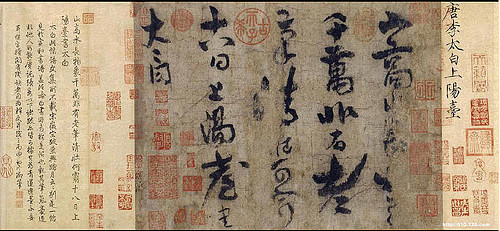
Li Po'due south Calligraphy
Calligraphy
The fine art of calligraphy - and for the ancient Chinese information technology certainly was an art - aimed to demonstrate superior control and skill using castor and ink. Calligraphy established itself equally one of the major Chinese art forms during the Han dynasty (206 BCE - 220 CE), and for two millennia after, all educated men were expected to be skilful at it. Some women, or at least certain figures at courtroom, did become known as achieved calligraphers, most notably Lady Wei (272-349 CE), said to have taught the dandy master Wang Xizhi (303-361 CE).
Far more mere writing, the art used varying thicknesses of brushstroke, their subtle angles, and their fluid connection to each other - all precisely arranged in imaginary spaces on the folio - to create an aesthetically pleasing whole. A connoisseurship chop-chop developed, and calligraphy became one of the 6 classic and aboriginal arts alongside ritual, music, archery, charioteering, and numbers.
The techniques and conventions of writing would influence painting where critics looked for the artist'southward forceful utilise of brushstrokes, their spontaneity, and their variation to produce the illusion of depth. Another influence of calligraphy skills on painting was the importance given to limerick and the employ of blank infinite. Finally, calligraphy remained then important that it even appeared on paintings to depict and explain what the viewer was seeing, signal the title (although by no means all paintings were given a title by the original artist) or record the identify it was created and the person it was intended for. Eventually, such notes and even poems became an integral part of the overall composition and an inseparable office of the painting itself. In that location was a fashion, too, for calculation more inscriptions by subsequent owners and collectors, even calculation extra portions of silk or newspaper to the original slice to adapt them. From the 7th century CE owners oftentimes added their own seal in red ink, for example. Chinese paintings information technology seems were meant to be perpetually handled and embellished with fine calligraphy.
Painting
Chinese painters painted on diverse materials in many formats. The almost popular formats were on walls (from c. 1100 BCE), coffins and boxes (from c. 800 BCE), screens (from c. 100 CE), silk scrolls which were designed to be looked at in the hand or hung on walls (from c. 100 CE for horizontal and from c. 600 CE for vertical), fixed fans (from c. 1100 CE), volume covers (from c. 1100 CE) and folding fans (from c. 1450 CE).

Chinese Eunuchs
The near popular materials with the earliest artists were wood and bamboo simply so the post-obit were adopted: plastered walls (from c. 1200 BCE), silk (from c. 300 BCE), and paper (from c. 100 CE). Sail would just be used widely from the eighth century CE. Brushes were made from animal hair, cutting to a tapering end and tied to a bamboo or wood handle. Significantly, they were precisely the same instruments used past the calligrapher. The inks used were made from rubbing a dried cake of creature or vegetable matter mixed with minerals and mucilage confronting a wet rock. Each artist had to laboriously make their own inks as there was no commercial production of them.
The ii well-nigh pop themes of Chinese painting were portraits & landscapes.
The two most popular themes of Chinese painting were portraits and landscapes. Portraits in Chinese art began in the Warring States Menstruation (fifth-3rd century BCE) and were traditionally rendered with great restraint, usually because the field of study was a great scholar, monk or court official and so should, by definition, accept a practiced moral character which should be portrayed with respect past the artist. For this reason, faces are often seemingly impassive with only the merest hint of emotion or character subtly expressed. Often the grapheme of the subject is much more than clearly expressed in their attitude and relationship to other people in the flick; this is particularly truthful of portraits of emperors and Buddhist figures.
There were, however, instances of more realistic portraits and these can be seen particularly in the wall paintings of tombs. A branch of portraiture was to paint historical figures in certain instructive scenes from their life which showed the benefits of moral behaviour. Naturally, at that place were too paintings of people which had less lofty aims, and these include the popular scenes of Chinese family unit life which are usually set in a garden.
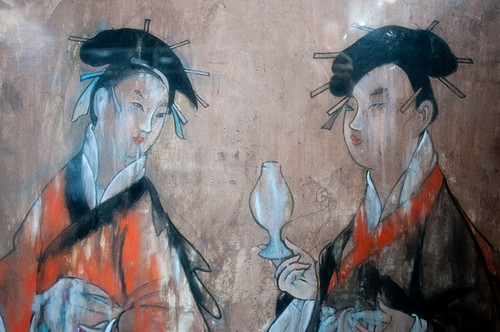
Han Women, Dahuting Tomb.
Landscape painting had been around as long as artists had, but the genre really took off during the Tang dynasty when artists became much more concerned with humanity's place in nature. Typically, small human figures guide the viewer through a panoramic landscape of mountains and rivers in Tang paintings. It should be no surprise that mountains and h2o dominated mural painting every bit the very give-and-take in Chinese for mural translates literally as "mountain-and-water". Copse and rocks are also featured and the whole scene is commonly meant to capture a particular season of the year. Colours were limited in use, either everything in various shades of a single colour (illustrating the roots in calligraphy) or ii colours combined, normally blues and greens.
In accordance with the Taoist belief in the do good of contemplating serene nature, in that location is rarely anything to disturb the tranquillity of mural paintings such equally farm labourers and no specific location is intended to be depicted. Subsequently periods would, though, see more than intimate and abstruse scenes of nature concentrating on very specific themes such every bit bamboo gardens. Detailed paintings of a single animal, flower, or bird were especially popular from the Song dynasty (960-1279 CE) onwards, but these were regarded equally artistically inferior to the other categories of Chinese painting.
However, certain animals became symbolic of certain ideas and appeared in paintings merely as they had already in other fine art forms similar bronze piece of work. For instance, a pair of mandarin ducks denoted a happy union, a deer stood for money, and fish for fertility and abundance. Similarly, plants, flowers, and copse had their own meanings. Bamboo grows straight and true like a good scholar should exist, the pine and cypress represent endurance, peaches long life, and each flavour had its own flower: peony, lotus, chrysanthemum, and prunus.
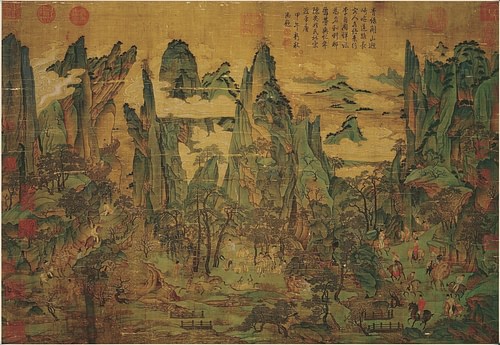
The Emperor Ming Huang Travelling in Shu
Depth was achieved in paintings past introducing mist or a lake in the center ground giving the illusion that the mountains are further backside. Other devices include using paler ink and fainter strokes to paint more distant objects while foreground objects are rendered darker and more detailed. Painting the scene with several unlike viewpoints and multiple perspectives is another mutual feature of Chinese painting. Ane of the most famous of all Chinese landscape paintings is the 8th century CE painted silk panorama known equally 'The Emperor Ming Huang Travelling in Shu'. Information technology is a sprawling and detailed masterpiece of mount scenery in the typical Tang style using only blues and greens. The original is lost but a subsequently copy can exist seen at the Palace Museum of Taipei.
Sculpture
Large-scale effigy sculpture has not survived well only some monumental examples tin can still be seen such as those cut from the rock face at the Longmen Caves, Fengxian temple near Luoyang. Dating to 675 CE the 17.four metre loftier figures represent a Buddhist Heavenly King and demon guardians. Another celebrated example of Chinese sculpture on a life-size scale are the figures of Shi Huangti's "Terracotta Army". Over 7,000 figures of warriors, 600 horses and several chariots were ready to guard the tomb of the 3rd-century BCE Qin emperor. Much effort was fabricated to render each figure unique despite them all existence made from a limited repertoire of assembled body parts made from moulds. Faces and hair, in particular, were modified to requite the illusion of a real ground forces composed of unique individuals.
Regarding smaller-scale works, the Shang Dynasty (c. 1600-1046 BCE) is famous for its cast bronze work. Common shapes of statuary vessels are three-legged cauldrons, sometimes with the legs made into animals, birds, or dragons. They can exist circular or square, and many have lids and handles. Sharp relief decoration includes repeating patterns, masks, and ringlet motifs. The Shang artists also produced vessels in the class of 3-dimensional animals such as rams, elephants, and mythological creatures.
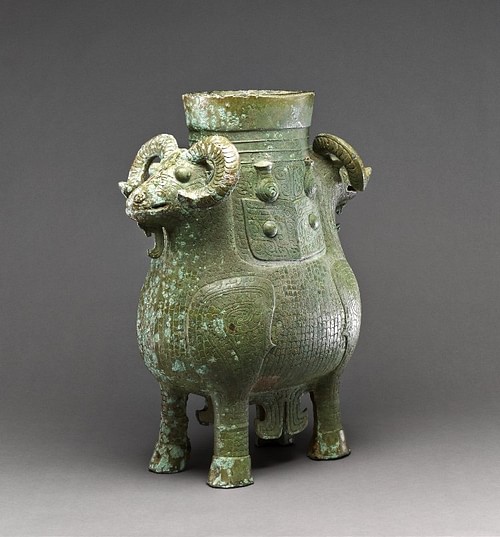
Shang Dynasty Bronze Zun
In the Han menstruation, modest-scale sculpture took the form of rock or bricks stamped and carved with relief scenes and they are particularly common in tombs. Outstanding examples come up from the Wu Liang Shrine at Jiaxiang. Dating to 151 CE or 168 CE, there are some 70 relief slabs which bear scenes of battles and famous historical figures, such every bit Confucius, all identified past accompanying texts and covering a chronological Chinese history in a pictorial record similar to a history book.
By the Tang dynasty, the wealth of the Buddhist monasteries permitted a great production of religious art.
Also in the Han period, cast bronze sculptures of horses were pop. These are unremarkably depicted in full gallop with only 1 hoof resting on the base and so that they almost appear to be flight. Earthenware figurines of single standing women, men, and servants are common from the Han period. Cast bronze was used to make small figurines and ornate incense burners. These were oftentimes inlaid with gold and silver or gilded. One superb piece is a gilded bronze oil-lamp in the form of a kneeling servant girl, which dates to the late second century BCE.
While the tombs of emperors and important people sometimes had large figure statues set outside them well-nigh later sculpture was of Buddhist subjects. By the time of the Tang dynasty, the wealth of the Buddhist monasteries permitted a not bad product of religious fine art. The about popular subjects, as always, were the Buddha and bodhisattvas, and they ranged from miniature figurines to life-size statues. Dissimilar in previous periods, figures became much less static, their suggested flowing movement fifty-fifty cartoon criticism from some that serious religious figures, on occasion, now looked more like courtroom dancers.
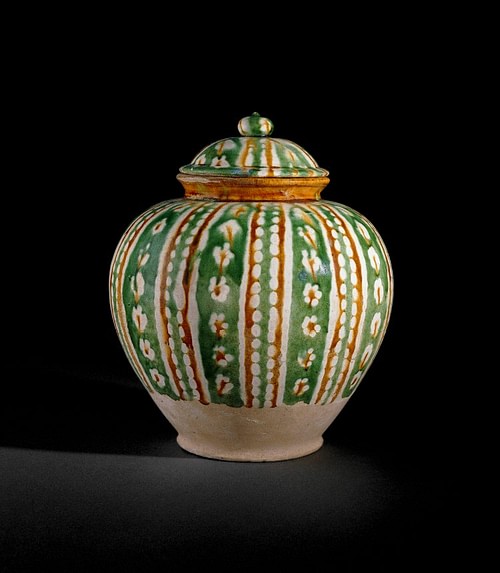
Tang Three-colour Glaze Jar
Pottery
The Chinese were the masters of pottery and ceramics. They produced everything from heavy and functional storage jars in earthenware to exquisitely decorated bowls in the well-nigh frail of porcelain, from vases to garden stools, teapots to pillows. They produced the showtime glaze wares, the first green celadons and the get-go underglaze wares painted with cobalt blue. Early on developments in techniques and kilns led to both higher firing temperatures and the outset glazed pottery during the Han menses. Pottery, especially the vessels painted with a grey slip commonly found in Han tombs, very often imitated the shape and decoration of bronze vessels, and this would be a goal of many potters in later periods. Clay was used to produce modest unglazed models of ordinary houses which were set up in tombs to accompany the dead and, presumably, symbolically meet their need for a new dwelling. Many such models are complete with adjacent animal pen and figurines of their occupants and animals.
Tang potters reached a level of technical proficiency greater than any of their predecessors. New color glazes which were adult in the menstruum included blues, greens, yellows, and browns, which were produced from cobalt, iron, and copper. Colours were mixed, likewise, producing the three-coloured wares the Tang period has go famous for. Rich inlays of gold and silver were too sometimes used to decorate Tang ceramics. In the Yuan (1271-1368 CE) and Ming (1368-1644 CE) periods even more famous ceramics would be produced with their distinctive and much-copied bluish on white decoration which itself copied earlier Chinese paintings for pattern ideas.
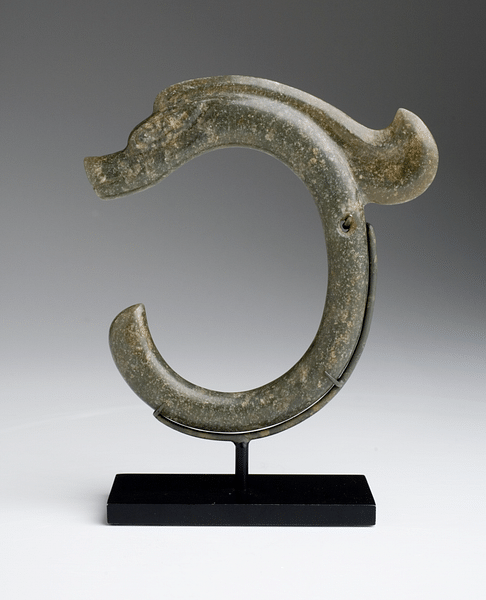
Hongshan Jade Dragon
Minor Arts
Gold, silver, copper, bronze, ivory, coloured glass, enamel, precious stones, semi-precious difficult stones, silk, woods, and amber were all materials transformed into art objects by gifted craftsmen, just perchance the most quintessential Chinese materials of the pocket-size arts were jade and lacquer. Jade was especially esteemed in China for its rarity, immovability, purity, and clan with immortality. Using circular cutting drills and atomic number 26 tools, the hard material was carved into all manner of jewellery items, everyday objects and figurines of animals, people, and mythical creatures, particularly dragons. Jade was specially used for ritual objects such equally the bi disc and zong (cong) tubes, both of which were made in big numbers simply are of unknown function. One unique but stunning use of jade was the creation of 'suits' to encompass the torso of the deceased in Han royal tombs. The 'suits' cover the contours of the torso and are fabricated from up to two thousand individually carved rectangular pieces of jade stitched together using gold or silvery wire.
Lacquer - a liquid of shellac and resin - was used to coat objects of wood and other material since the Neolithic period in China. It was used to colour and beautify screens, furniture, bowls, cups, sculpture, musical instruments, and coffins, where it could be carved, incised, and inlaid to prove off scenes from nature, mythology, and literature. The state sponsored and supervised the production of lacquerware, with different schools of lacquer art producing mutual forms simply with recognisably distinct designs. Lacquerware took the form of plates, cups, and jars. Like pottery, they frequently imitated metal vessels, but they were decorated more elaborately, particularly with scenes of mythical creatures appearing from backside clouds and probably representing the spirit world of the afterlife.
This article has been reviewed for accuracy, reliability and adherence to academic standards prior to publication.
Source: https://www.worldhistory.org/Chinese_Art/
0 Response to "Sirãƒâ©n Architecture Iv of a History of Early Chinese Art"
Postar um comentário