Peer Reviewed Articles Disposal of Infants in Roman Ashkelon Israel
INTRODUCTION: THE HYPOTHESIS OF INFANTICIDEFootnote 1
Infant burials have been widely discovered on settlement sites in Roman Britain but there has hitherto been little attempt to understand them contextually. Nosotros contend that they deserve conscientious report and analysis as an understanding of the rites surrounding their burial has the potential to contribute to a fuller and broader knowledge of social relations inside Roman United kingdom. Previous word of infant burying in Roman Great britain has, however, focused either on the idea that neonatal deaths were non mourned and hence their bodies were unceremoniously disposed of in rubbish deposits, or that groups of such burials represent evidence for the deliberate disposal of unwanted infants who had been killed at birth. There has been picayune systematic evaluation of the commencement thought, while debates accept instead centred on the possible do of infanticide. Evidence in back up of this hypothesis has been presented in a series of papers by Mays and his associates, which focus on the fact that an unexpectedly high proportion of these infants died at around the time of birth, at the age of 38–42 gestational weeks.Footnote 2 This idea is based on empirical ascertainment of skeletal remains in addition to parallels drawn from excavations at Ashkelon in Israel, which supposedly demonstrate the practice of infanticide elsewhere in the Roman Empire.Footnote 3 More recently, Mays' studies take focused on the much-discussed assemblage of infant burials excavated at Yewden (Hambledon, Bucks.) in the 1920s.Footnote iv Mays' overall decision is that infanticide was widely practised in Roman Britain — and elsewhere across the Empire — with a probable bias towards the killing of females. The publicity surrounding the publication of the Yewden materialFootnote 5 has given much emphasis to interpretations which motility far beyond any credible reading of the evidence with the suggestion that the site was a brothel,Footnote 6 echoing the interpretation of the Ashkelon site.
A number of authors have already questioned Mays' conclusions based on both scientific method and a more careful reading of the ancient textual testify.Footnote 7 First, it has been shown that the method used for the original assay probably overemphasised the tightness of the superlative in the age distribution around the time of nascency (fig. 1).Footnote viii Second, it has been noted that the textual show Mays relies upon does not support whatsoever unproblematic model of infanticide. Rather, the exposure of infants was a more complex and nuanced phenomenon, with many infants who were rejected by their parents at birth likely to have been adopted by others.Footnote 9 Furthermore, it is noted that whatsoever such infants who died following exposure after birth are most unlikely to have been cached in any archaeologically recoverable fashion.Footnote 10
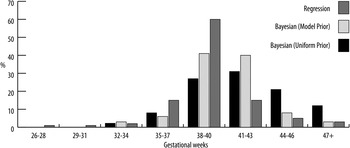
FIG. one. Comparison of the infant age-at-expiry distributions obtained using regression versus Bayesian methods of analysis (n = 164). (Drawn by Lacey Grand. Wallace later Gowland and Chamberlain 2002)
In addition to these points of criticism, we may note that reliance on archaeological parallels from the other finish of the Roman Empire is probably unwise since there is very considerable evidence that religious behavior and burying practices showed significant regional and interprovincial variation, not to mention the problems of alter through time.Footnote 11 The evidence from Ashkelon in State of israel is specially problematic. First, the publication of the excavated prove cited by Mays does not provide any precise stratigraphic or contextual bear witness for the infants discussed across the fact that they were found in a sewer, so the excavators' determination that they were a product of infanticide is unsupported and relies on a questionable and intuitive assertion.Footnote 12 Second, the cultural context is one where there is very specific bear witness for the special treatment of dead infants arguably associated with long traditions of child sacrifice.Footnote thirteen Irrespective of how the Ashkelon evidence might be interpreted, there tin can be no question that Roman Palestine is contextually very different from Roman Britain.
Finally, we may annotation that the previous proposition that infanticide was directed towards females seems to have been undermined past the ancient Dna studies of the biological sex of these infants. Opposite to expectations, the ancient Dna study of the infants from Ashkelon revealed an backlog of males over females,Footnote 14 while the study of the Yewden infants demonstrated no meaning sex-bias. For Ashkelon, sex activity was established for merely 19 out of the 43 infants sampled (yielding 14 males versus 5 females), while at Yewden but 12 out of the 33 infants sampled yielded a sexual activity (yielding vii females versus 5 males).Footnote xv Given the pocket-sized proportion of the total samples that yielded a biological sex in each of these studies, no definitive conclusions can be drawn.
As a consequence of this body of piece of work, baby burials in Roman Britain are now often accepted equally representing victims of infanticide. This is despite the premise being repeatedly contested by authors who accept instead highlighted the fact that conscientious choices announced to have been made in terms of age-at-death and the location of these burials.Footnote xvi As Eleanor Scott states: 'if nosotros can get by the Victorian obsession with baby-dropping, we might be able to notice complex patterns of ritual and ideological treatment of deceased infants…'Footnote 17 With this in mind, this written report aims to provide a detailed examination of two large samples of infant burials from Romano-British sites in East Yorkshire.
AN Culling APPROACH
A different explanation for the widespread occurrence of baby burials lies in the likelihood of high infant mortality in Roman Britain and, especially, a meridian in deaths effectually the time of birth. Natural baby mortality statistics demonstrate that this pattern is the norm and is likely to have also been the case in Roman United kingdom of great britain and northern ireland.Footnote xviii However, information technology is well known that loftier frequencies of neonatal infants tend non to be recorded in excavated cemeteries from this period, or indeed cemeteries of other periods. There are a few exceptions to this rule, including Poundbury, Dorset,Footnote 19 only even here neonatal infants are still under-represented given the large size of the cemetery population. The absence of the expected number of infants and children from cemeteries suggests that formal burial within such contexts was not the universal practice for all age and sex groups in Roman Uk.Footnote 20 Ane must, of grade, also consider taphonomic factors regarding the poorer preservation of baby basic and recovery biases,Footnote 21 only these do non provide a consummate caption given the high frequency of these historic period-groups excavated from not-cemetery sites.Footnote 22 It seems clear that there must have been a multifariousness of different funerary rites and these may accept been dependent upon aspects of social identity such as historic period, gender and ethnicity. The question then arises equally to how and where other members of the population were disposed of at death.
Part of the answer to this question must lie in the occurrence of infant burials in settlement sites which, as we have noted, is a widespread phenomenon. However, in an infant population with natural causes of death we would look there to be a range of ages-at-decease represented, with a representative proportion of premature infants, likewise every bit a number who survived for a few months later on birth, in addition to those who died at nativity. The studies by Mays cited above betoken that there are fewer premature and older infants than we should look, hence his conclusion that the acme at full-term is not a natural phenomenon. The re-evaluation by Gowland and ChamberlainFootnote 23 argued for the presence of a broader range of ages-at-death, though a neonatal peak was still nowadays, albeit less pronounced (fig. ane). If it is non a product of infanticide as Mays suggests, then why is there this bias towards neonatal infants in the archaeological record?
As Mays and Eyers stated in discussing the Yewden burials:
A further possibility is that for some reason, the excavated area at Hambledon was used for burials of mainly full-term infants, with most slightly younger or older ones existence buried elsewhere. The Hambledon perinatal historic period distribution resembles those produced from other Roman sites in Britain (Mays Reference Mays1993), so for this to be an explanation information technology would have to apply more generally, with interment of pre-term foetuses and infants dying in the first few weeks of life in ways which accept left no trace archaeologically. We know of no evidence that this sort of burial selection process was carried out in the Roman World.Footnote 24
Information technology is our contention that evidence for such a pattern does be and has been constitute on sites in East Yorkshire, initially noted at Shiptonthorpe,Footnote 25 and now reinforced by farther show from Hayton (fig. two).Footnote 26 This prove may exist summarised every bit follows.

FIG. 2. Map showing the location of the sites in East Yorkshire and at Hayton mentioned in the text. (Drawn by Lacey K. Wallace)
PATTERNS IN THE Evidence: SHIPTONTHORPE
Excavations on the Roman roadside settlement at Shiptonthorpe between 1985 and 1991 revealed a full of 22 baby burials plus five individuals who were cremated. The inhumations were published by J. Langston with the cremated remains analysed by G. Marlowe and L.C. Winter.Footnote 27 The largest grouping of infant burials came from Trench 3 which explored a single domestic unit that was occupied from the second to the fourth centuries and information technology is hither that we have clear evidence for their spatial patterning. Langston's analysis of the age-at-death of the infants (Tabular array one; fig. iii) showed that the vast majority died in the menstruum effectually full-term (38–twoscore gestational weeks), thereby plumbing fixtures in with the pattern discussed past Mays. However, an analysis of the distribution of the 11 burials of Phases 4 and 5 (early to mid-4th century) in Trench 3 suggested a conscientious blueprint of burial. The rite was a simple one with each burying contained in a pocket-sized pit in a domestic context, but there was a clear spatial pattern evident (fig. 4). The 8 burials in Trench iii that could be aged were around 38–forty gestational weeks and at that place was a main cluster (of seven individuals) effectually the eastern terminate of the principal domestic building excavated (Construction 3.3), plus one beneath its main hearth, one simply outside the wall to the southward, and two others beside its northern extension (Stage v) in the vicinity of a waterhole. It was concluded that this represented a specific burial rite reserved for those who died effectually the time of nascency.Footnote 28

FIG. 3. Historic period-at-death of infant burials from Shiptonthorpe (data from Table 1). (Drawn by Lacey Thou. Wallace)
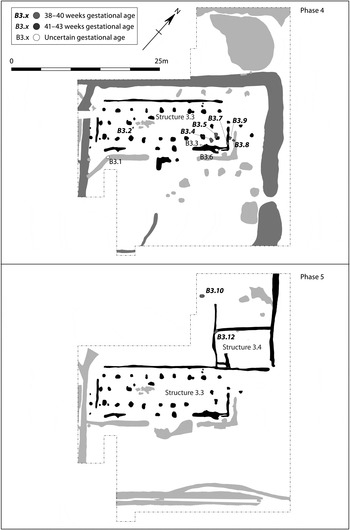
FIG. 4. Plans of Shiptonthorpe Trench 3 showing the location of the babe burials in site Phases iv and 5 (fourth century a.d.). (B = Burial) (Drawn by Lacey M. Wallace)
TABLE 1. SUMMARY OF THE BURIALS FROM SHIPTONTHORPE

PATTERNS IN THE Testify: HAYTON — Age-AT-Expiry
Following on from the work at Shiptonthorpe, the excavations on the site at Burnby Lane within the landscape projection at Hayton, initiated in 1995, paid particular attention to the outcome of baby burial, with care taken over their on-site identification and recording.Footnote 29 Additional evidence about Roman-period burial in the Hayton study area was afterwards provided by work about by at 2 other sites, Glen Garth excavated by MAP in 2002 and at the adjacent Turn Inn excavated past Humber Field Archaeology in 2006, although the circumstances of these excavations were far from ideal (fig. ii).Footnote 30 The human remains from the Burnby Lane site were studied by J. Langston and R. Gowland, while those from Glen Garth and the Plough Inn were recorded past J. Higgins and V.J. Wastling respectively.Footnote 31
The Burnby Lane excavation investigated a domestic site which dated from the mid–late Iron Age through to the fourth century and produced burials of 52 people, of whom 41 were infants. At that place were 43 individuals, including only four infants, from the adjacent sites at Glen Garth/Plough Inn, which included a formal cemetery used from the late Roman period into the early Heart Ages. Three of these infants (2 premature and one a few months erstwhile) came from a domestic enclosure, and only one (of uncertain historic period) came from the cemetery. The historic period distribution of all the Hayton burials is shown in Table 2 and fig. 5. The Burnby Lane prove shows a very stiff emphasis on infants aged 38–40 gestational weeks, merely with a broader representation of ages than seen at Shiptonthorpe. By contrast the Glen Garth/Plough Inn evidence shows an age distribution more similar to many other Romano-British cemeteries. It is also notable that neonatal infants (aged 38–40 gestational weeks) are absent-minded from these sites, although younger individuals were found. This is perhaps a function of the nature of the Glen Garth settlement excavation, which was undertaken under exceptionally difficult atmospheric condition. As has been noted in an earlier publication,Footnote 32 the high recovery of infant burials in the excavations at Shiptonthorpe and Burnby Lane is partially a result of an excavation strategy which involved digging all features initially classified as post-holes. Such sampling is rarely possible on commercial projects for obvious reasons of time force per unit area.
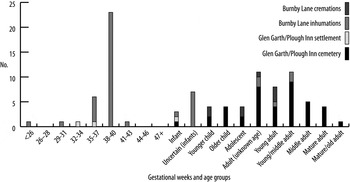
FIG. 5. Historic period-at-death of burials from Hayton (information from Tabular array ii). (Drawn by Lacey M. Wallace)
Table 2. AGE RANGES OF ROMAN HUMAN BURIALS FROM HAYTON
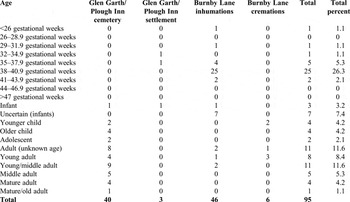
What we see in the dissimilarity in age distribution between the domestic context at Burnby Lane and the formal cemetery at Glen Garth/Plow Inn is evidence for the differentiation of burial context by age-at-death. It seems clear from this that neonatal infants were normally buried in a domestic context, and that adults were generally placed in a separate formal cemetery. The pattern for pre-full-term infants and older infants/children is less clearly seen, partly because of a lack of testify, which might itself suggest that such children were generally cached in a dissimilar context which we have yet to notice.
In relation to this, it is worth considering a grouping of three cremation burials found on the Burnby Lane site.Footnote 33 The two improve-preserved urns both contained double burials, each with an adult female interred together with a child (aged respectively 2–4 and 6–8 years). Ii like cremation burials contained within urns that were found at Shiptonthorpe likewise held multiple burials: Cremation 1.1, two adults, i possible male, plus a kid; Cremation 1.2 developed plus child.Footnote 34 Neither child could be aged. These graves perhaps support the idea that children were given a different burying rite to infants on the ane hand and adults on the other.
The spatial distribution of burials at Burnby Lane, Hayton will be considered below merely we may note that both hither and at Shiptonthorpe, these cremation burials were found tightly clustered within the settlement, close to, only just outside, occupied domestic enclosures (fig. 8). Although the numbers are small, it is hard to believe that this pattern of multiple individuals in single graves plus the clan of an developed (or in one case two adults) with a child can be the product of take chances. Furthermore, it seems improbable that each pair of people died at the aforementioned time — unless the cremation rite was reserved for such occasions. Its repetition suggests that one of the dead had been kept, either every bit a torso, or as cremated remains, until the death of an advisable burial partner. In this context it is notable that at Burnby Lane the pottery vessel that contained one of these paired burials was itself unusually old when deposited. It is maybe more likely that information technology was a child'southward body that was curated in this way, until the decease of a parent (or, once, perchance both). It remains unclear whether the first death was immediately followed by the cremation of the body, or whether it was kept and so cremated at the same time as the accompanying person. In either case, such curation of human being remains has considerable implications for the general representation of dissimilar age cohorts. It besides raises the question of whether cremation itself was a rite that was universally adopted in this area, as is normally assumed, or one that was confined to particular social circumstances. These questions certainly deserve further inquiry equally new bear witness is discovered in the futurity. If such a design of burial was more widespread in Roman Britain this would have significant implications. It suggests, for instance, that the widespread supposition that any woman establish buried together with an infant had died in childbirth needs re-evaluation.
PATTERNS IN THE EVIDENCE: HAYTON — BURIAL LOCATION
In contrast to the evidence from Shiptonthorpe the associations betwixt baby burials and excavated structures at Burnby Lane are more than complex, partly because of the more bitty nature of the structural bear witness and partly because of the site'south complex sequence. However, despite some uncertainty in the phasing of individual burials, there is again strong show for a pattern of conscientious degradation of neonatal infants within a domestic context, close to occupied buildings. Furthermore, given the longer sequence than at Shiptonthorpe, it is possible to examine the show chronologically.
In the late Iron Historic period phases (fig. 6), in that location is a cluster of infant burials in the western enclosure (Enclosure two.1) to the east of the main domestic roundhouse, with another burial inside the door of the primary structure (Roundhouse 2.1). Those to the e were all anile around full-term (38–40 weeks), while the infant beside the door was slightly younger (37+ weeks). There were also two developed burials of this period. A female was buried in Iron Historic period tradition, laid in a flexed posture on her left side and facing east, in the s-eastern corner of the same settlement enclosure (Burying ii.1) and an isolated adult skull (Burial 2.nine), besides probably female, was establish just to the south-east of the roundhouse. This suggests a pattern of gendering of the domestic space marked by female and infant burials in the eastern function of this enclosure which echoes that noted at Shiptonthorpe. A further three infant burials (the two for which an age estimate was possible being 38–xl weeks) were found in the ditch and gully which marker the boundaries of the adjacent enclosure to the east along with an developed human skull (Burial 2.6) found about by on the eastern purlieus. The location of these burials on the enclosure boundaries also indicates a conscientious pattern, again with a focus on the eastern side. However, in dissimilarity to the western enclosure, these burials were not associated with the roundhouses, which in this role of the site practice not seem to have served a domestic purpose. The bear witness from this stage demonstrates that the conscientious burying of full-term infants close to the domestic sphere was a tradition that was already firmly established here during the later Iron Age.
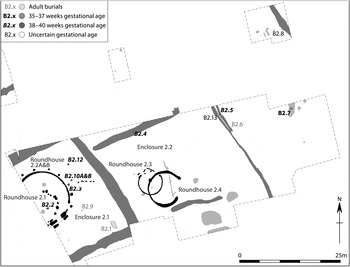
FIG. 6. The distribution of Iron Historic period–early Roman burials at Burnby Lane (site Periods 2.one and 2.2: mid/late Fe Historic period to early 2nd century a.d.). (B = Burying) (Drawn past Lacey K. Wallace, based on plan by Helen Woodhouse)
In the early to mid-Roman period (fig. 7), six infant burials (all that were aged existence around full-term, 38–40 weeks) were amassed in a single area at the northern end of a major domestic edifice (Building iii.ane), both within the construction and in the g immediately exterior. An older infant (Burial three.31), anile nine–12 months, was found farther southward in the courtyard of this building, and a further isolated infant burial of uncertain age was located within Enclosure 3.3A farther to the east. This over again shows a stiff spatial clustering of neonatal infant burials in a domestic context, simply without any evidence for a preference for the eastern end of the edifice every bit seen elsewhere. The layout of Building iii.i is non sure, but the clustering does appear to be associated with its northern wing.

FIG. seven. The distribution of early–mid-Roman burials at Burnby Lane (site Catamenia 3.i: second century a.d.). (B = Burial) (Fatigued by Lacey G. Wallace, based on plan by Helen Woodhouse)
In the mid-Roman catamenia (fig. 8), there are two clusters of babe burials. A grouping of 4 individuals (3 aged 38–xl weeks, the other 41–43 weeks) lay nigh to those of the preceding flow to the east of the Edifice 3.1, and immediately to the south of the bathroom-business firm. In that location is probably a mixture of factors accounting for this pattern, combining the tradition of burial in this zone with proximity to the new structures. The 2d group of four (three aged 38–xl weeks, the other of uncertain historic period) was located to the east of another domestic building (3.2) inside the eastern enclosure and on its boundary (Ditch 3.7 and Enclosure Ditch 3.3). These two clusters seem to indicate a recurrence of a preference for easterly locations. There was also a group of cremation burials of this catamenia interred to the north-west, nigh a and then-disused boundary ditch (come across to a higher place).
In the later on Roman period (fig. 9), the babe burials were more dispersed, with three in the vicinity of the bath-house — under its northern extension, in the yard to its due north, and in the area to its south; all continuing earlier locational patterns. One was aged 41–43 weeks, only the other ii, perchance significantly, were less than full-term, perhaps hinting at a unlike pattern associated with the baths. (An extended male person adult burial, Burial 4.40, was too plant to the due north of the bath-house, but this may date to after its demolition.) The seven other infant burials of this catamenia were establish effectually the walls of the eastern role of a poorly surviving stone building (4.5) which was probably domestic, and were plant both to its e and along its south side. Of the six that can be anile, one was aged 37 weeks, the others 38–40 weeks, continuing the previous rite of selective burial. There was too an isolated observe of an adult skull from this period (Burial 4.39).

FIG. 8. The distribution of mid-Roman burials at Burnby Lane (site Period three.2: third to early fourth century a.d.). (B = Burying) (Drawn past Lacey M. Wallace, based on plan by Helen Woodhouse)
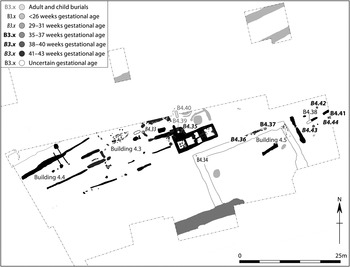
FIG. nine. The distribution of later on Roman burials at Burnby Lane (site Period four: mid to afterwards fourth century a.d.). (B = Burial) (Drawn by Lacey Chiliad. Wallace, based on plan by Helen Woodhouse)
In summary, at Burnby Lane at that place seems to be a strong clustering of neonatal infant burials that implies that their interment was governed past social rules. Taken with the contemporary show from Shiptonthorpe, we can encounter a blueprint of their burial close to domestic buildings, with some apparent preference for the eastern side. This peradventure implies a gendering of space within these buildings with the eastern side associated with women and with childbirth as discussed past Scott.Footnote 35 The other obvious design for the burial of full-term infants shows an association with purlieus locations around domestic habitations, where there is over again a preference for locations to the e and likewise mayhap to the n. There is little to imply any chronological modify in rules governing spatial patterning, although there is perhaps evidence that the strength of clustering weakened through time. In general premature infants and those who died after birth are less well represented in the evidence and we would propose that they were subject to different social rules with their burial probably taking place in other locations. There is slight evidence that we may be seeing some location and ritual patterning in these groups; get-go with the cluster of premature infants around the bath-house in the later Roman phase, and secondly with the burial of the cremated remains of some children together with adults at both Burnby Lane and Shiptonthorpe.
PATTERNS IN THE Testify: HAYTON — BURIAL RITUAL
Although there is articulate evidence from the Burnby Lane earthworks for the very careful location of infant burials, the bear witness does not reveal any discernible preference for their orientation, or the side upon which they were laid. We also lack unambiguous evidence for the presence of grave appurtenances (with occasional objects included being virtually likely the outcome of casual inclusion of refuse within grave fills). One time, an baby was carefully placed in the grave underneath an imbrex tile, in some other a tegula was used. Otherwise, burials were made in small pits without archaeologically detectable ceremonial, presumably indicating that they were wrapped in cloth.
Intriguingly the Burnby Lane site also produced an unusually large number of animal burials, including a substantial number of deposits that seem to take been associated with communal feasting on lambs and sheep. Analysis of these deposits suggests that they were the product of celebrations marking stages within the homo life-cycle.Footnote 36 Given the general spatial association of these feasting deposits with human burials on the site, it may be that there were funerary feasts held at the burial of these infants. If then, this would reinforce the suggestion that they were buried with ceremony according to articulate social rules and non simply 'disposed of' equally is sometimes unsaid. Scott has also highlighted the high frequency of beast bones associated with infant burials at villa sites, which she interprets as having votive significance.Footnote 37
General DISCUSSION
The evidence from Hayton and Shiptonthorpe corresponds with patterns of infant burials observed nigh byFootnote 38 and elsewhere in Roman Britain. In discussing the infant burials from domestic contexts at High Wold Bridlington, Roberts has drawn attention to others from the regionFootnote 39 to which we may at present add those from beside a purlieus at Melton.Footnote 40 These oftentimes demonstrate the careful location of neonatal infant burials in the domestic sphere. It is as well clear from the contextual prove that such burials are contemporaneous with the home of these dwellings. For example, at Winterton, Lincs., three infant burials were sealed between successive floor layers,Footnote 41 and at Bradley Hill, Somerset, the infant burials were overlain past occupation debris.Footnote 42
The infant burials at Hayton, along with those observed elsewhere, are not haphazard, but are specifically placed next to features and walls. The burials inside buildings are often located in the corners of rooms, which may represent spatially the liminal status of these infants. Examples include all seven of the infant burials from Bucknowle Farm Villa which are located in the corners of adjacent rooms;Footnote 43 at Catsgore four of the 5 infant burials within the building were located in the corners of the room,Footnote 44 and at Stanton Low all four infant burials were located in corners.Footnote 45 A number of infant burials have also been recovered from outbuildings and workshop areas, as seen with certain of the burials from non-domestic features in the tardily Iron Age phase of Hayton. For instance, at Rudston Roman Villa, Yorks., several of the buildings with infant burials contained hearths and corn-drying kilns and were described as workshops.Footnote 46 At Littlecote Park Villa, Wilts., of the v infant burials, two were associated with domestic rooms and three were associated with a statuary-working furnace.Footnote 47 At both Catsgore and Bradley Loma, Somerton, infants had been buried in dwelling houses and out-buildings.Footnote 48 Scott highlights an association between babe burials and contexts interpreted as corn-driers at sites such as Yewden and Barton Court Farm, Oxon. She interprets this in terms of the gendering of domestic and agricultural space, potentially symbolising a link between fertility and agricultural production.Footnote 49 Moore also concludes that the burying of infants was 'non the random disposal of the unwanted or marginalised, but the result of careful choices and decisions'.Footnote fifty The evidence from Hayton and Shiptonthorpe supports her observations almost the clan betwixt babe burials and both liminal locations and hearths.
I of the over-riding impressions from the spatial distribution of these infant burials is the consequent desire to maintain a physical and symbolic connection betwixt the female parent (or family) and baby. In Western discourse we consider bodies to be detached, bounded entities, and life courses to be, likewise, separate, linear, biographies. This is not a universal viewpoint and many cultures view life courses to exist inter-connected and cyclical, and bodies to be 'partible'.Footnote 51 It could be argued from the bear witness discussed to a higher place that infants in Iron Age and Roman Britain were not considered to be carve up entities and instead were an indivisible part of the mother. This is a concept that has been observed ethnographically, with abortion for some cultures considered a class of self-mutilation considering the foetus is not seen to be dissever from the female parent.Footnote 52 In the Western world, where the developing foetus and mother have been increasingly conceptualised as distinct, some women even in tardily pregnancy have difficulty conceiving of the foetus as separate from themselves.Footnote 53 Cantankerous-culturally it has been observed that the mother does not merely figuratively 'lose a part of herself' with the death of her newborn, simply does so in a very literal sense. The pattern of burying signals an unease with the complete severance of this connexion between mother and baby and an apparent need to sustain this link through proximity between the living and the dead. This may also explicate the cremated burials of developed females at Hayton inside the domestic sphere — perhaps the females in these instances were survived by their infants and this connection yet needed to exist maintained after the mother's decease, i.e. the aforementioned pattern in contrary. Another example of this is observed at Rudston Roman Villa where a young woman is also buried in the vicinity of a edifice with infant burials.Footnote 54
Although we should exist cautious about using literary testify from the centre of the Empire in the context of agreement Roman Britain, the 'otherness' of infants in the Roman globe is attested in historical texts. The physiology of an infant's body was considered distinct from older children and adults; it was conceptualised as notwithstanding 'moisture' and wax-like.Footnote 55 Co-ordinate to Pliny and Juvenal a child was not considered to be a separate individual until the 2d half of the beginning year, in one case teething and possibly walking and talking had commenced.Footnote 56 Pliny explained that children who had not teethed were not cremated (the predominant rite at that fourth dimension) and that intra-mural burying, especially nether the eaves of buildings, while forbidden by police force for older individuals, was customary for young infants.Footnote 57 Pearce notes that the transition from inhumation to cremation from approximately six months of historic period is documented in a number of cemeteries from the Roman provincesFootnote 58 and the later age of cremation appears to be borne out by the data at Hayton and Shiptonthorpe. Overall, all the same, he highlights that the age categorisations identified through differentiation in burying practice do not correspond with the general constructs for Roman order as indicated past the textual sources.Footnote 59 Age-related burial practices in Roman United kingdom and the periphery of the Empire are likely to have evolved out of local traditions, every bit indicated at Hayton, and are unlikely to faithfully replicate age norms from the cadre of the Empire in Italian republic. The special status of the newborn infant is enacted repeatedly in the funerary rite from Roman Britain. The liminal condition is attested in the location of the infant next to boundaries, most notably walls, or sites of transformation, such as hearths or agricultural features. The indivisibility of the female parent/baby entity is performed through the proximity of the baby to the domestic space.
CONCLUSIONS
The show presented in this paper demonstrates that the burial of infants at these ii sites was not a product of careless disposal, and far less does it provide whatsoever evidence to suggest that infanticide was practised. Rather it shows that dissimilar social groups inside the population, certainly defined past age and probably past other aspects of social identity besides, were afforded burial according to social norms, which meant that they were not all cached in the same location or in the same manner. While it does not wholly resolve the problem of understanding the social rules which governed burial in this area during the menses, information technology does go some way towards it. It highlights that the careful burying of infants has its origins in the pre-Roman Fe Age. Similarly, it shows that neonatal infants were closely associated with the domestic sphere. The entrenching of deceased infants firmly within the social sphere of the living, implicates their continued social agency and provides insights into understandings of the mother/infant dyad. We would not pretend that our conclusions should be practical universally, but rather would look social norms to vary with infinite and time beyond Britain and the Roman earth. We would thus contend that nosotros take evidence for social practice in this region and that comparable patterns should be sought through a very conscientious examination of the evidence from other areas. We trust that this evidence disposes in one case and for all with the proposition that infanticide was the norm in Roman United kingdom of great britain and northern ireland.
Source: https://www.cambridge.org/core/journals/britannia/article/infant-and-child-burial-rites-in-roman-britain-a-study-from-east-yorkshire/1C9DEC59492051F0999405E4D7BB7FD7
0 Response to "Peer Reviewed Articles Disposal of Infants in Roman Ashkelon Israel"
Postar um comentário